
Durable. Functional. Attractive.
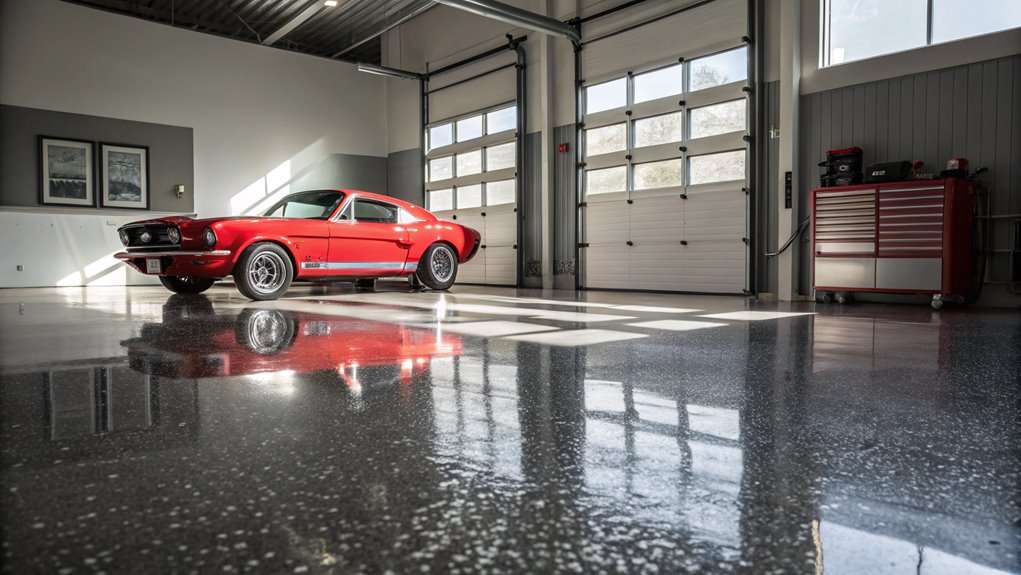
When somebody says an epoxy floor failed, this is usually what they saw. A car is driven home, the tires are warm and slightly soft, and the vehicle is parked on the same two patches of floor it always is. Heat and pressure work on the coating, and when the car pulls away weeks later a patch of finish comes with the tire.
It is a bond and hardness problem rather than a wear problem. A film that is soft, too thin, or poorly bonded to the concrete gives up under a warm tire long before it wears out from foot traffic. Film hardness is graded under ASTM D3363, which pushes calibrated pencil leads across a cured surface until one of them cuts in, and the result says a great deal about whether a floor will survive being parked on.
This is also why the cheap version of a garage floor rarely lasts. A single thin coat rolled onto lightly cleaned concrete has neither the film build nor the bond to resist it. Professional garage floor epoxy in Castle Rock, CO is specified with that specific load in mind, because in a garage it is the load that matters most.
Strength. Value. Longevity.
Interior slabs get covered before they are ever used. A garage slab spends years absorbing whatever is dropped on it, and by the time anyone thinks about coating it there is oil in the concrete under the engine bay, road salt worked into the surface, and often an old sealer or a previous coat of paint on top of all of it.
That changes the work. Oil has to come out of the pores rather than off the surface, because a coating over contaminated concrete bonds to the contamination instead of the slab. Old sealers have to be removed for the same reason. What is left is then opened up to a measured texture, compared against the ICRI concrete surface profile chip set so the roughness is a specification rather than an opinion, and the resulting bond can be checked under ASTM D7234, which glues a dolly to the cured coating and pulls until something lets go.
None of that is visible in the finished floor, which is exactly why it gets skipped. It is also the difference between a coating that lasts and one that peels in sheets two winters later. The same prep question decides how a commercial floor holds up.
Bare concrete does not shed dust because it is dirty. It sheds dust because the top layer of a finished slab is weaker than the concrete underneath it. Troweling brings fines and water to the surface, and what cures there is a thin, soft skin that breaks down under tires and brooms into the grey film that settles on everything in the garage.
Sealing it slows that down. Coating it removes the problem, because the weak layer is ground off during preparation rather than sealed in, and what is left is sound concrete with a bonded film on top. That is also why a coated floor stays cleaner than a sealed one. There is nothing left to break down.
It matters more in a garage than anywhere else in a building, because it is the one floor where the dust has somewhere to go. Anything stored along the walls collects it, and so does whatever is parked in the middle. It is one of the reasons a coated floor in Castle Rock gets noticed straight away.
How long it lasts depends on the preparation underneath it and the traffic it carries. Rather than quote a number, EvrStep backs its work with a 21-year delamination warranty covering the bond between coating and slab. Homeowners and businesses trust EvrStep for expert installation that maximizes durability.
Yes, epoxy is engineered to resist tire wear, impacts, and daily use. EvrStep provides coatings in Castle Rock that perform reliably even under demanding conditions.
Absolutely. Epoxy floors are non-porous and easy to clean with simple sweeping or mopping. EvrStep ensures professional garage floor epoxy in Castle Rock, CO delivers both durability and convenience.
Not directly. Whatever is already on the slab becomes the surface the new coating bonds to, so an old paint or sealer layer has to come off first. That is mechanical work rather than a chemical shortcut, and it is one of the main reasons two quotes for the same garage can differ so much.
Cleaning removes what is sitting on the surface. Grinding opens the concrete so the coating has somewhere to key into, and it takes off the smooth top layer that forms when a slab is finished. A coating applied to a sealed, polished surface has very little to hold on to no matter how clean it is.
The staining does not have to disappear cosmetically, but the oil does have to come out of the pores. A darkened patch that is chemically clean is fine to coat. A patch that still holds oil below the surface will push the coating off in that spot, which is why the area under an engine gets extra attention.