
A garage floor that looks clean on the surface can still fail within two years if moisture vapor rises through the concrete slab after installation, and most coatings are applied without any barrier because the problem is invisible until delamination starts. The blistering and peeling that appear later require complete removal and reinstallation, turning a protective investment into a costly redo. EvrStep Epoxy Coatings installs garage floor flake systems in Parker with a moisture vapor barrier base coat applied to every floor as standard practice, specified against a measured slab reading before the decorative layers go down.
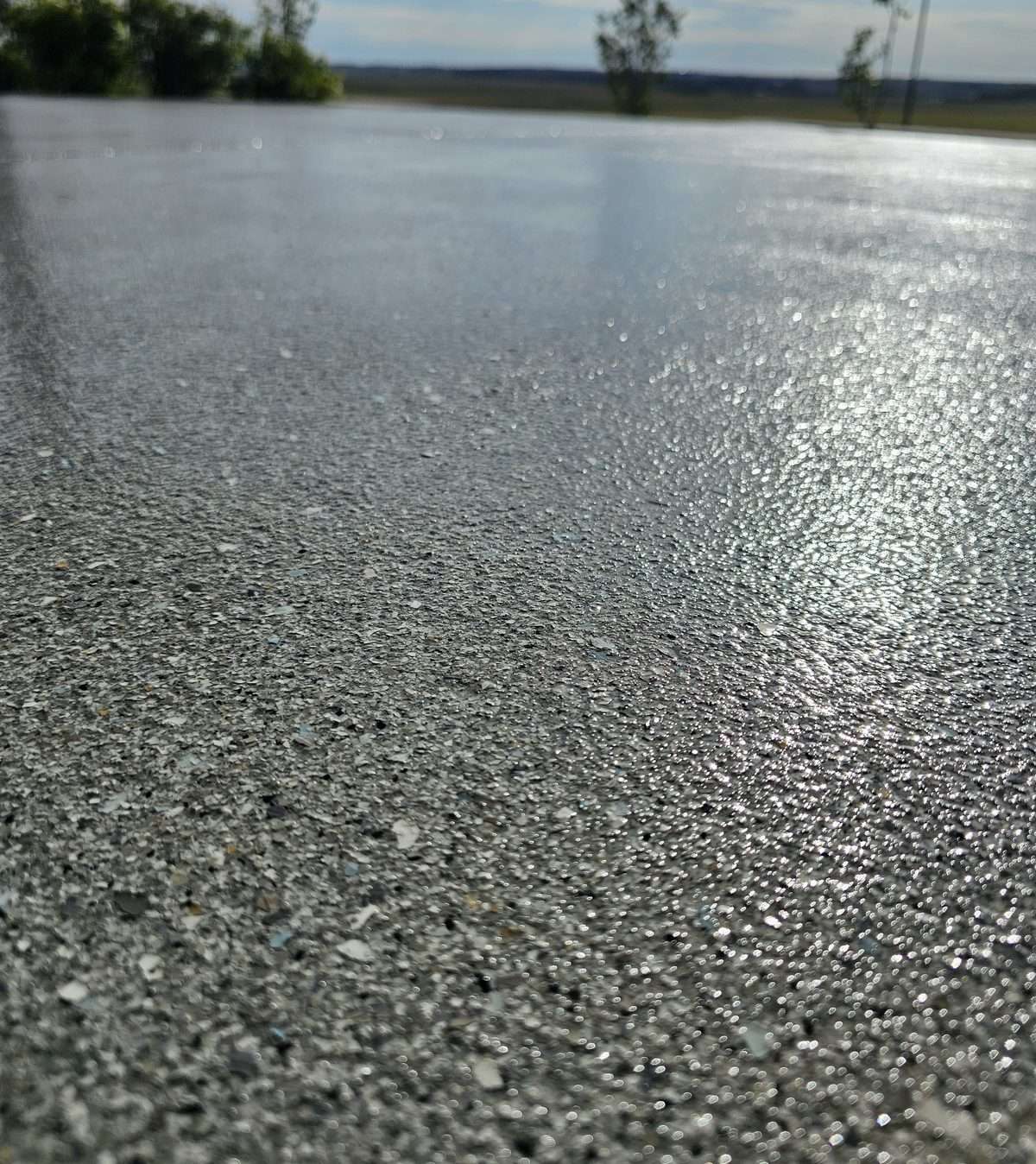
Garage floor flake systems that survive Colorado freeze-thaw cycles and road salt exposure require installers with documented surface prep standards and verified warranty backing. EvrStep Epoxy Coatings holds credentials that reflect both technical rigor and accountability in Parker’s residential market.
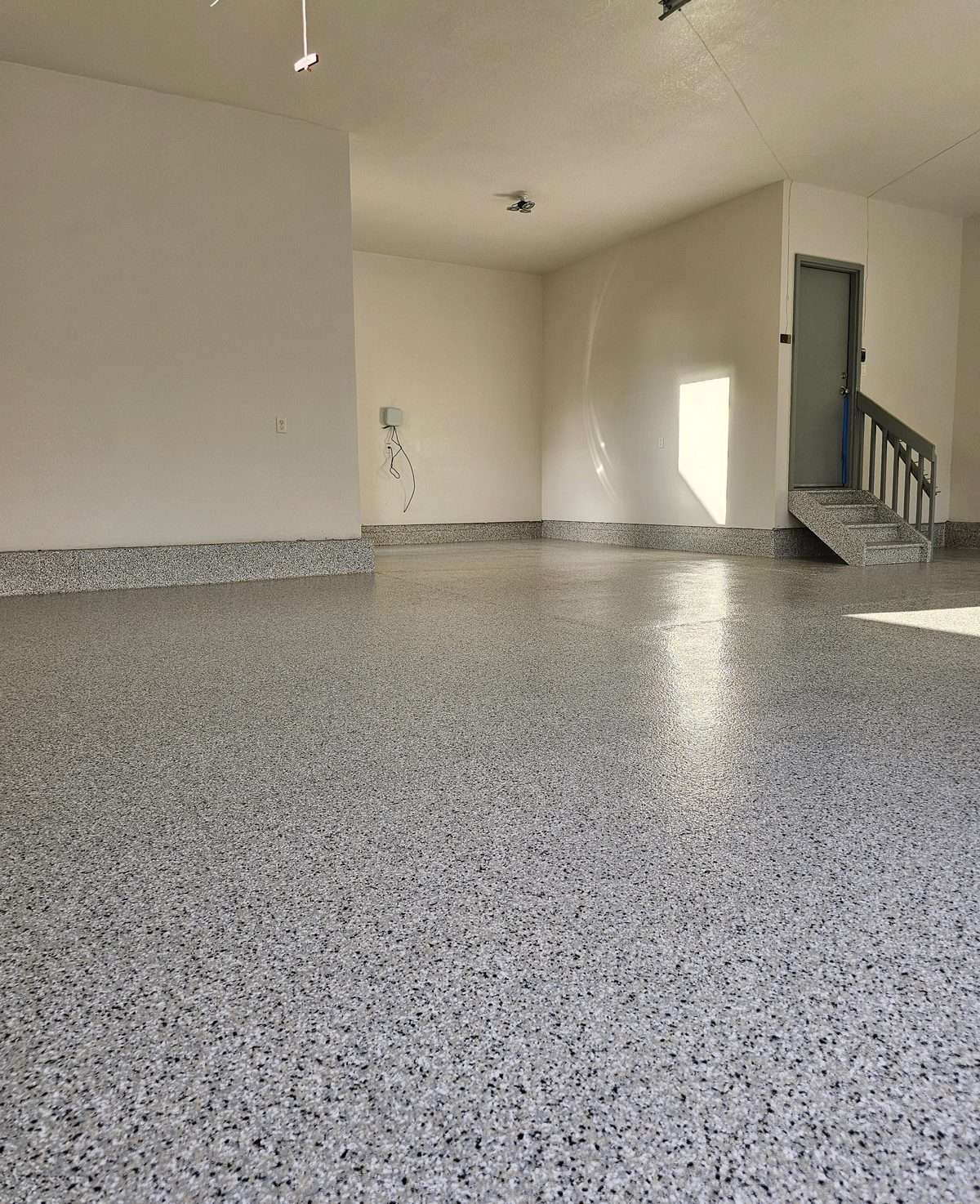
If you have ever stood in a garage showroom staring at sample boards and wondered what actually makes one of the garage floor flake systems different from another, you already understand the problem. Most homeowners choose based on color and leave the job site, hoping the layer underneath was built correctly.
Garage floor flake systems fail first in Parker when the application is the one that looked perfect at handoff but skipped moisture testing on a slab that read dry to the touch. Concrete can carry a vapor load invisible to the eye, and that pressure lifts the new surface from below within a season or two.
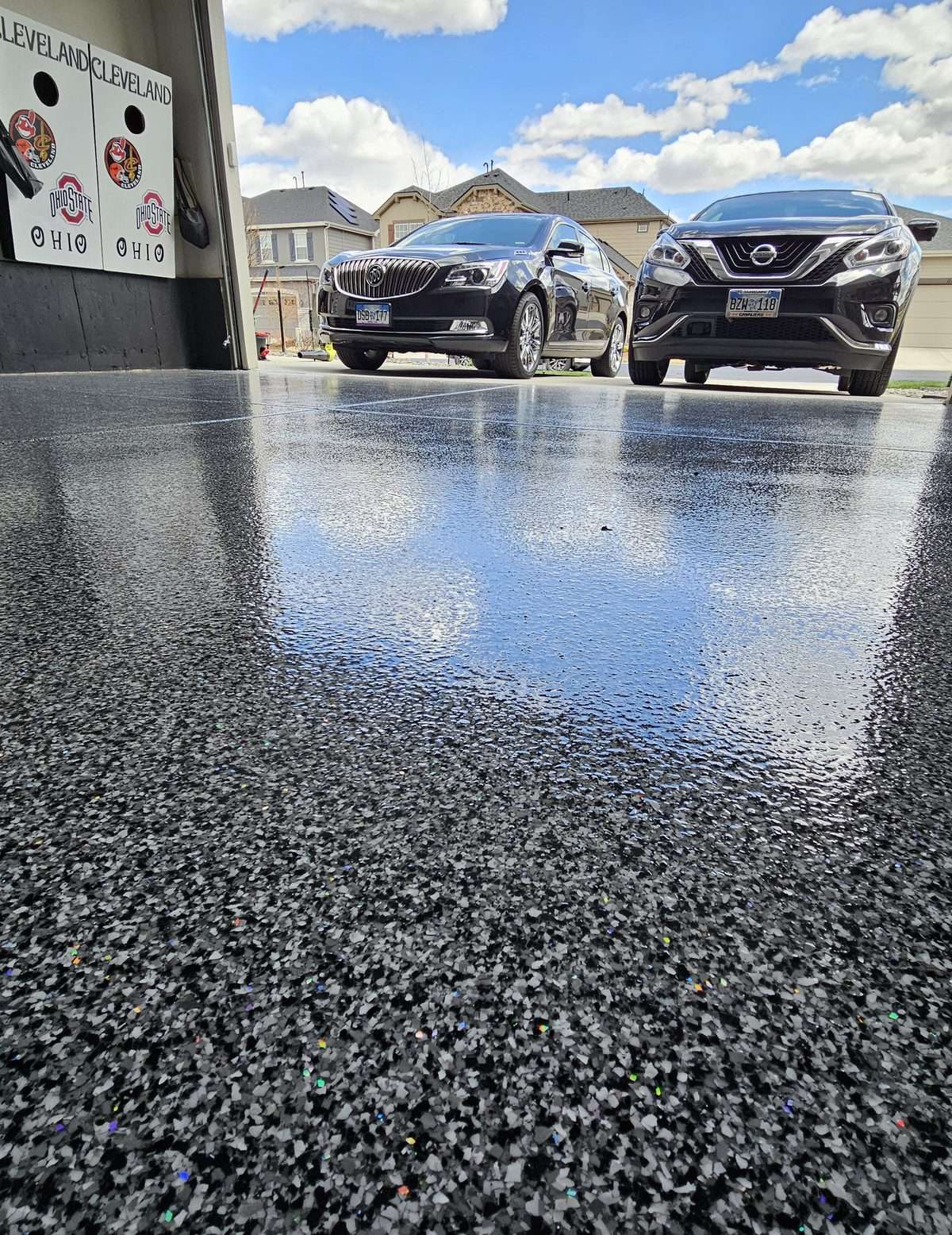
The three-stage build separates durable garage floor flake systems from decorative failures. Moisture testing and mechanical prep determine adhesion longevity. The topcoat chemistry determines whether the finish yellows or holds at the sunny threshold where most Parker garages fail.
At EvrStep Epoxy Coatings, we test relative humidity per ASTM F2170 and grind to ICRI CSP 2 to 3 before any coating touches concrete.
We roll a pigmented epoxy base and broadcast vinyl flakes to rejection, a process that typically costs $7 to $8 per square foot in Parker.
After scraping excess flakes and vacuuming, we apply an aliphatic polyaspartic topcoat. Clarence found his floor held through two winters without a lift at the threshold. Diane’s garage transformed into a space she actually wanted to use.
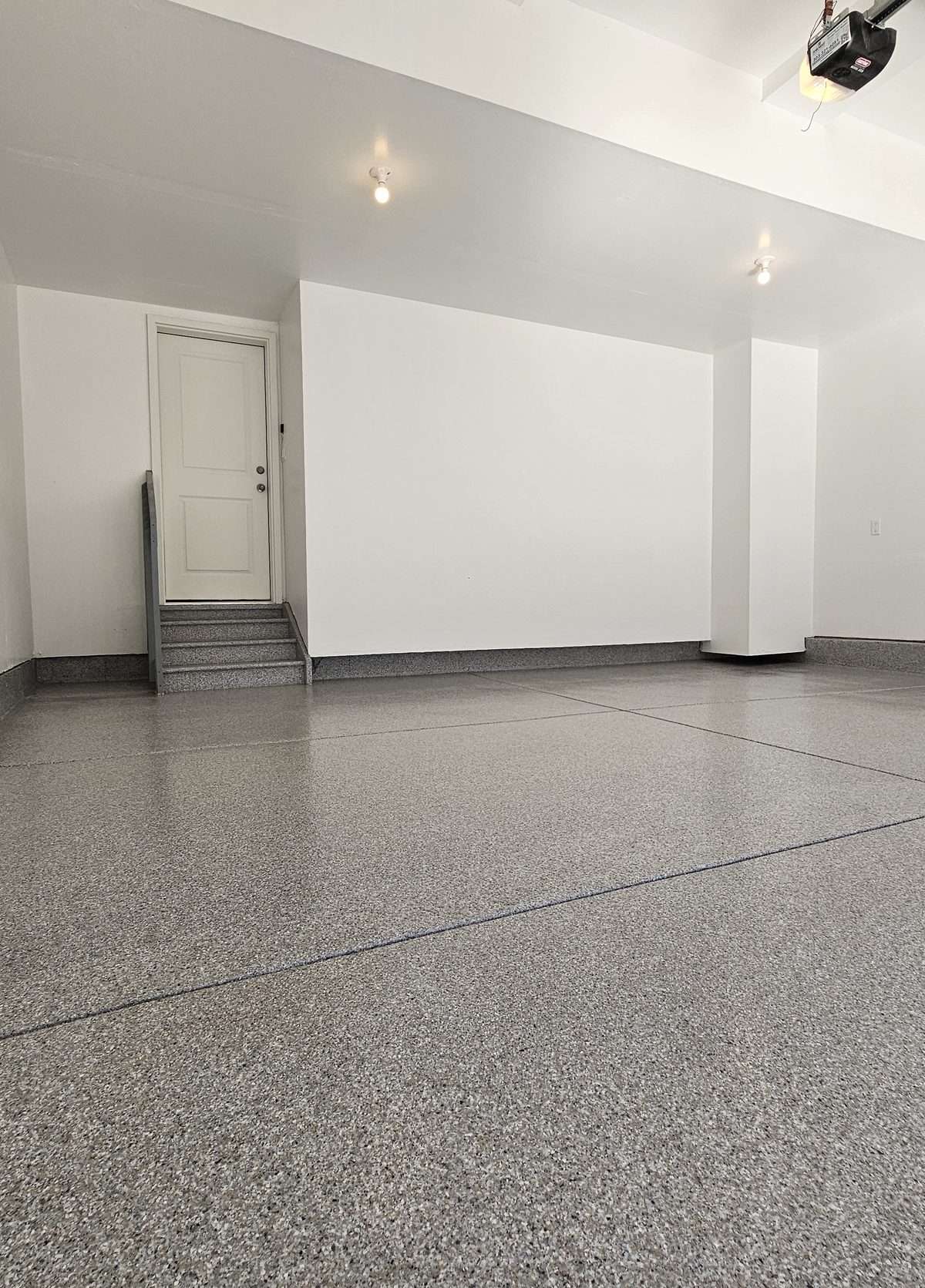
The coating that fails fastest is usually the one installed without accounting for Parker’s seasonal moisture swings and UV exposure at elevation. Moisture testing, primer selection and topcoat chemistry decide whether garage floor flake systems hold or delaminates, not flake color or brand reputation.
Most moisture tests run at installation capture a single-day snapshot, missing seasonal vapor transmission cycles that peak during Parker’s spring thaw and late-summer monsoon humidity. Troy needed a polyaspartic system that could handle scheduling complexity and substrate variability. We ran RH testing per ASTM F2170, applied an MVR epoxy primer where readings exceeded thresholds, and delivered a build that held through two full freeze-thaw cycles without a single lift at the threshold.
Flake size and broadcast density control camouflage. Quarter-inch chips at rejection coverage mask spalling and minor cracks. Sparse broadcasts or oversized flakes create visual gaps that spotlight every substrate flaw instead of burying it. Bobbi arrived frustrated after years of watching an aged, cracked slab collect stains and dust. We diamond-ground to CSP 2, filled cracks with polyurea, broadcast Torginol flakes to refusal, and added a six-inch cove base. The surface that once looked neglected now reads uniform, and the cleanup that used to require scrubbing takes a single pass with a damp mop.
Aliphatic polyaspartic resists yellowing under UV load at elevation, where Parker garages near south-facing thresholds see intense solar gain. Standard epoxy clear ambers noticeably sooner under the same exposure. At a typical range of seven to eight dollars per square foot for residential garage floor flake systems, the delta between chemistries is modest relative to the lifespan gain and aesthetic stability you preserve.
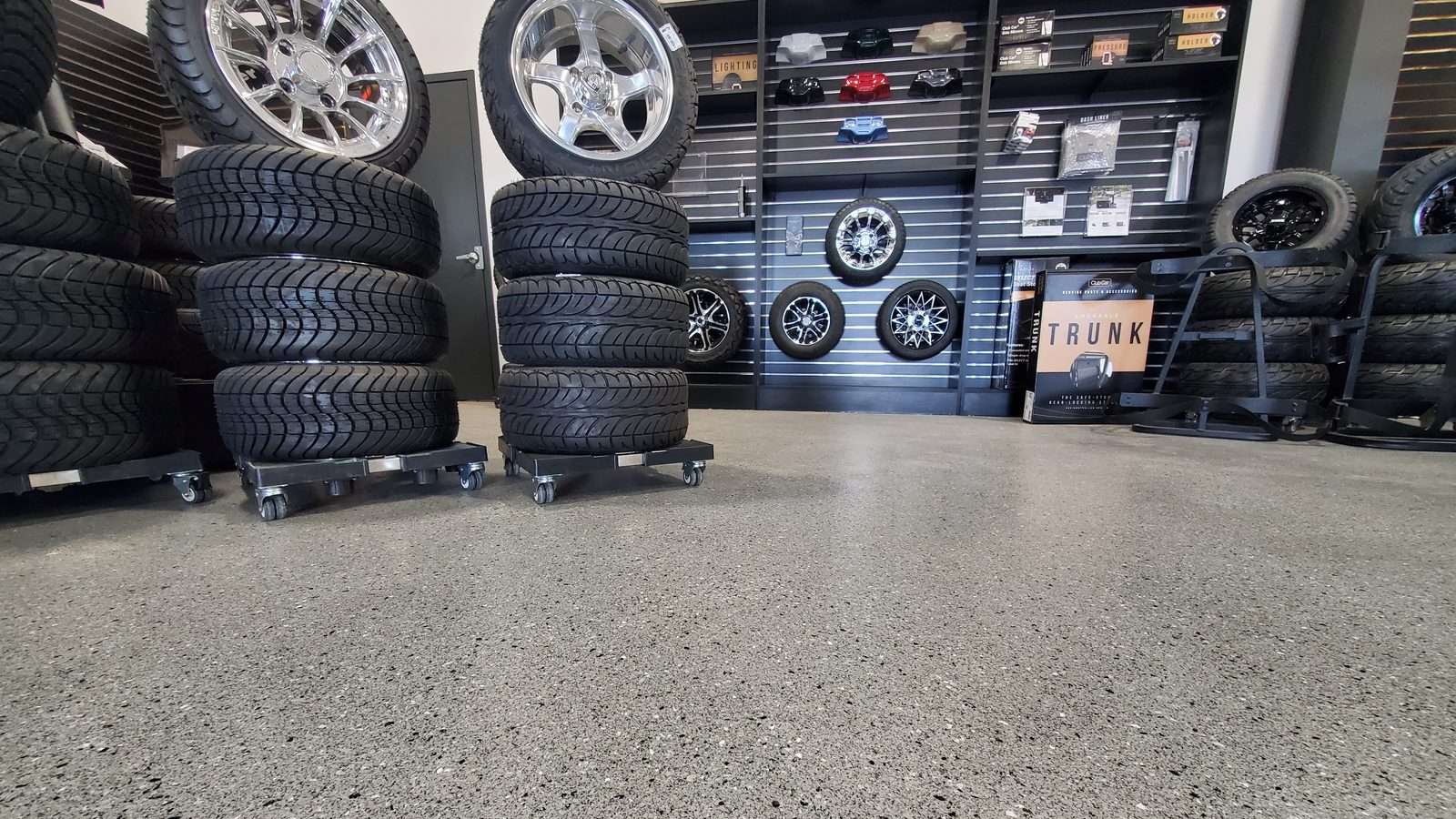
Step three above says scrape, vacuum, then seal. It is one line in a process list and it is the step that decides how the finished floor feels underfoot, so it is worth the paragraph it never gets.
Flakes are broadcast to rejection, which means the installer keeps throwing them into the wet base until the surface will not absorb any more. Manufacturers build whole systems around the technique, and a decorative flake broadcast data sheet sets out the layer order it assumes. Doing it that way guarantees full coverage with no thin patches, and it also guarantees a mess. Flakes land at every angle. Some stand on edge, some lie flat, and a loose layer sits on top held by nothing at all.
Scraping knocks down the upstanding flakes and shears off the high points, and vacuuming takes away everything that was never bonded. What is left is a surface the topcoat can wet out properly, which matters because a clear coat poured over loose flake bonds to the loose flake rather than to the floor. That is the failure that shows up as patches lifting cleanly away a year later with flakes still stuck to their underside.
The scrape also sets the texture. Taken back hard, garage floor flake systems finish smoother and clean more easily but give up some grip. Left coarser, they hold more traction and catch more dirt. It is a choice rather than a byproduct, and it is worth saying out loud before the topcoat goes down, because afterwards it is fixed.
Ask how the floor will be scraped and how much texture you are getting. It is a question about the part of the job that happens after the decorative decision is already made, which is exactly why garage floor coatings are better judged by process than by a sample board.
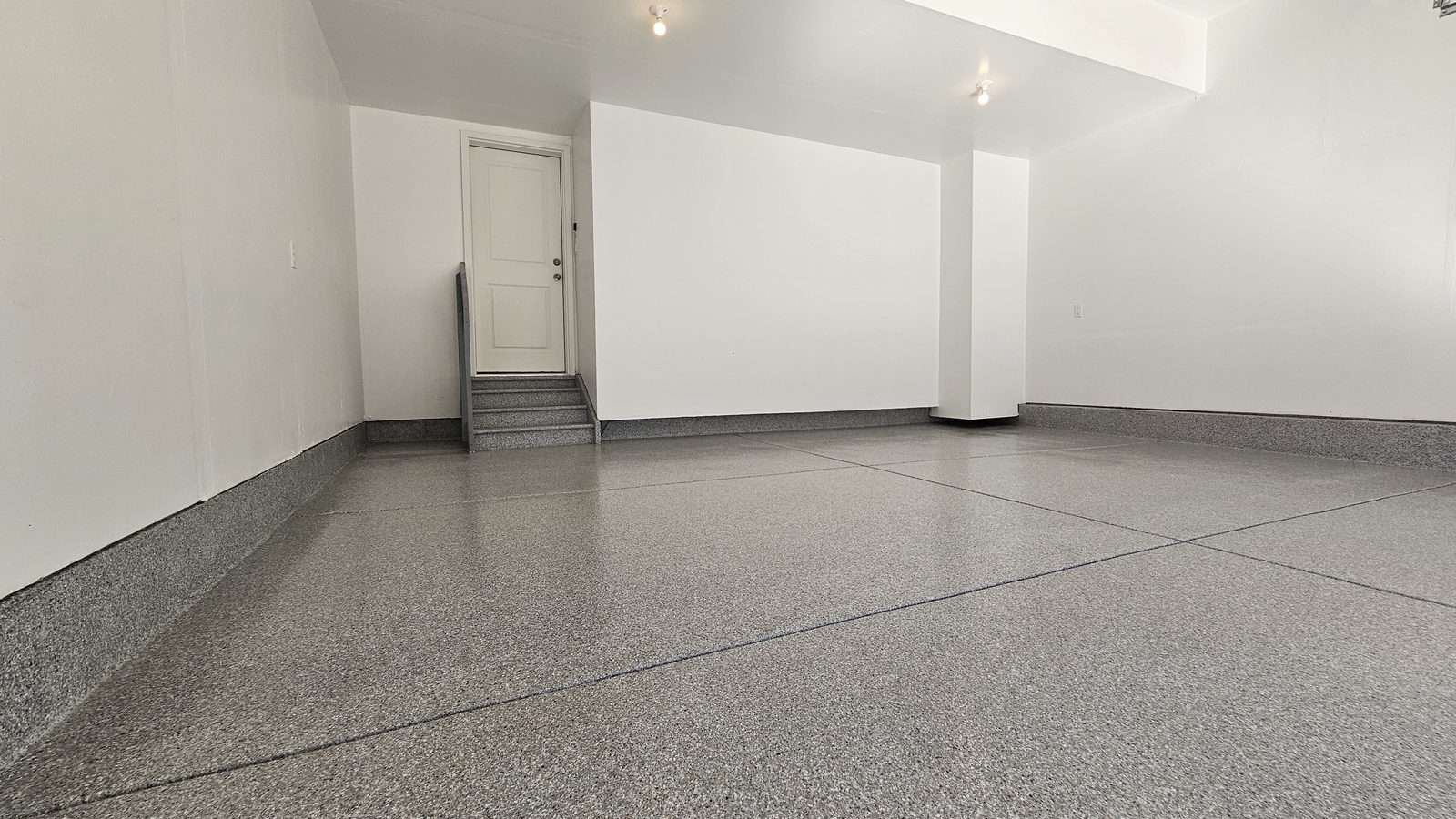
The page opens by saying most homeowners choose on color and then leave the job site. Color is the easy part. What the floor is actually like day to day gets discussed far less, and it is the part you notice every morning.
Underfoot, a flake floor is not smooth. The finished surface has a fine grain to it, somewhere between a matte wall and very fine sandpaper depending on how hard it was scraped. That grain is what gives it grip when meltwater comes off a car in February, and it is also why a dropped socket skitters less far than it would on bare sealed concrete.
Cleaning changes more than people expect. There is nothing porous left for oil or salt to soak into, so spills sit on the surface and come up with a damp mop instead of a scrub. The trade is that the same texture holding traction also holds fine grit, so a garage that gets a lot of dirt tracked in wants an occasional pass with a stiff broom or a shop vacuum before mopping.
The flake pattern does a quiet job too. A busy blend hides tire dust, footprints and the odd stain between cleans in a way a single solid color never does, which is why a plain floor often looks dirtier faster even when it is not. Lighter blends also bounce the light around and make a windowless garage read brighter.
None of this is a reason to choose or avoid garage floor flake systems. It is the information that turns a sample board into a decision you will still be happy with in three winters, and it is worth asking about alongside the polyaspartic topcoat that goes over the top.
EvrStep Epoxy Coatings serves homeowners throughout Parker and surrounding Douglas County communities, delivering garage floor flake installations directly at residential properties. From Stonegate to Castle Rock, the team reaches Parker-area homes via I-25, E-470, and Parker Road, traveling to neighborhoods across the Front Range corridor. EvrStep Epoxy Coatings completes full-broadcast flake installations with 24-hour foot traffic return and 48-hour vehicle load clearance, applying moisture vapor barrier base coats on every floor as standard practice.
Parker Coverage Zone
Installations follow a meticulous surface preparation protocol, including diamond grinding to CSP 2-3 and ASTM F2170 moisture testing before any coating application begins.
Flake epoxy systems last between five and fifteen years, depending on surface preparation quality, traffic patterns, and UV exposure from windows or open doors.
Surface prep determines longevity more than product choice. Floors ground to proper profile and free of moisture issues hold coatings far longer than chemically etched surfaces. Traffic matters less than you’d expect. Daily vehicle movement causes minimal wear compared to hot tire pickup, which happens when fresh asphalt transfers onto cured epoxy during summer months. Garages with west-facing doors in Parker see faster UV degradation on exposed sections. Recoating those areas every seven years keeps the system intact without full removal.
Professional garage floor flake systems use industrial-grade resins and controlled application environments that DIY kits cannot replicate. Longevity depends on substrate preparation depth and proper moisture mitigation, which home kits typically skip.
DIY kits fail at the substrate level. Most homeowners skip concrete profiling, which means the coating sits on top of the surface rather than bonding into it. EvrStep Epoxy Coatings grinds Parker garage floors to expose the concrete pores, removes all contaminants, and tests for moisture vapor transmission before any material goes down. The flake broadcast itself requires specific timing. Apply too early and the flakes sink into wet epoxy, creating texture problems. Wait too long and they won’t embed properly. Temperature control matters more than most realize. Garage floors in Colorado swing between hot afternoons and cool evenings, which changes cure rates. Professional installations account for ambient conditions and adjust mix ratios accordingly.
The topcoat application separates adequate floors from durable ones. EvrStep Epoxy Coatings applies polyaspartic or polyurea sealers that cure harder than standard epoxy alone, creating chemical resistance that home kits cannot match. A proper system lasts decades, not years.
Proper surface preparation includes diamond grinding to open concrete pores, crack repair, and oil stain removal. Skipping these steps causes premature delamination regardless of coating quality.
Surface preparation determines whether garage floor flake systems last two years or twenty. EvrStep Epoxy Coatings grinds every garage floor with diamond tooling to create the mechanical profile epoxy needs to bond. This removes the top layer of concrete, opens pores, and eliminates surface contaminants that prevent adhesion. Concrete that looks clean still carries oils, curing agents, and sealers invisible to the eye.
EvrStep Epoxy Coatings refuses to coat over questionable surfaces. Floors with moisture issues or structural damage get flagged before installation begins. The Parker climate creates specific challenges with temperature swings and garage humidity that affect cure times and adhesion windows.
Properly installed garage floor flake systems resist hot tire pickup and thermal cycling when the substrate is correctly prepared and the topcoat is fully cured. Failures occur when installers skip moisture testing or apply coatings over weak concrete.
Hot tires pull up poorly bonded coatings. That happens when moisture is trapped in the slab or when surface prep skips diamond grinding. Parker’s temperature swings stress the bond line twice daily during spring and fall. A flake system needs mechanical anchor points, not just chemical adhesion. Installers who rely on acid etching alone create smooth profiles that fail under thermal load. The topcoat matters more than most homeowners realize. Polyaspartic and polyurea finishes cure hard enough to resist tire imprint, but only after full cross-linking completes.
Garage floor flake systems offer dozens of color combinations and three flake sizes (small, medium, large) that affect both appearance and texture. Coverage density determines whether the base coat shows through or disappears completely beneath the flakes.
Flake size changes the entire character of the floor. Small flakes create a tight, almost terrazzo-like surface with subtle texture. Medium flakes give the classic garage floor look most people recognize. Large flakes make bold statements but create more surface variation, which some homeowners love and others find too aggressive underfoot. The base coat color matters more than most people expect. Dark bases with light flakes create high contrast. Matching tones produce a blended, sophisticated look. In Parker garages with natural light from windows, flake density becomes critical because sunlight reveals every gap in coverage.
Full broadcast coverage (flakes applied until no base shows) delivers uniform color and maximum slip resistance. Partial broadcast leaves intentional gaps, showing the base coat as part of the design. That choice affects maintenance visibility, since tire marks show differently depending on flake density and color contrast.