
A garage floor that looks clean after sweeping still releases concrete dust into the air and is tracked into the house, and oil stains that wipe off the surface have already soaked into the porous concrete below, which is why the same spots darken again within weeks. The moisture vapor moving up through the slab is invisible until the coating bubbles or delaminates, and by then the floor needs to be stripped and restarted. EvrStep Epoxy Coatings installs epoxy garage floors in Parker using a moisture vapor barrier base coat on every floor, specified against a measured slab reading rather than assumed.
A Better Business Bureau A+ rating and owner-operated accountability reflect the standards behind the epoxy garage floors EvrStep Epoxy Coatings installs in Parker. Documented prep protocols and warranty terms separate installers who stand behind their work from those who disappear after the check clears.
If you have ever watched a coating peel at the threshold where tires track in the most moisture, you already understand what longevity actually depends on. Epoxy garage floors fail first in Parker when the finish is the one that tested fine at 60°F, the application temperature where most installers schedule work, and the temperature that least resembles a February morning when the slab is actually stressed.
Diane came to us after a previous coating bubbled within eighteen months, frustrated by the money spent on a floor she had already paid for once. We ran ASTM F2170 in-situ RH testing, found readings at 87 percent, applied a moisture vapor barrier base layer, then built the pigmented epoxy and polyaspartic topcoat over a verified substrate, and the surface held through two full winters without a single lift or blister at the threshold.
Most failures on epoxy garage floors trace back to skipped diagnostics, not material choice. The slab condition determines system design. Testing moisture, profiling depth, and repairing substrate before application prevents the callbacks that happen when installers guess instead of measure.
At EvrStep Epoxy Coatings, we run ASTM F2170 in-situ RH probes on every slab before any material touches the surface, eliminating guesswork about vapor pressure.
George came to us needing work finished before his move-in deadline, anxious about timing; we diamond-ground to CSP-3, routed cracks, and completed ahead of schedule.
Bobbi’s aged garage had extensive cracking and needed six-inch cove baseboards for waterproofing; the layered system with moisture barrier typically runs $4 to $9 per square foot installed.
The questions that matter most before epoxy garage floors go down are the ones buyers do not think to ask: what the moisture reading actually is, whether the slab temperature supports the cure window, and whether prep cost reflects real substrate issues or just aesthetic add-ons.
Concrete that appears dry visually can still emit vapor pressure from below that pushes coatings off within months. ASTM F2170 in-situ RH testing reveals subsurface moisture the eye cannot detect, which is why we run probes before every Parker installation. David came to us after a mountain garage project with foam expansion joints needed flattening and smoothing before the epoxy could go down. The substrate work took an extra day, but the coating held through two full winters without a single lift at the seams.
Cure chemistry and slab temperature control the timeline, not installer preference. Polyaspartic topcoats cure faster than traditional epoxy at lower temperatures, but applying any system below 50°F extends return-to-service windows regardless of product claims. Tim needed his garage back quickly for a work truck and storage reorganization. We scheduled during a warm week, completed the build in one day with tight dust containment, and the surface was ready for full vehicle weight within 24 hours as planned.
Not when the cost difference reflects decorative upgrades rather than substrate prep or moisture mitigation. In Parker and Denver, installed pricing typically runs $4 to $9 per square foot, with premium systems reaching $12 to $20 when extensive crack repair, moisture vapor barriers, or metallic finishes are involved. The system that lasts is the one built on a verified surface profile and controlled moisture, not the one with the most expensive flake blend.
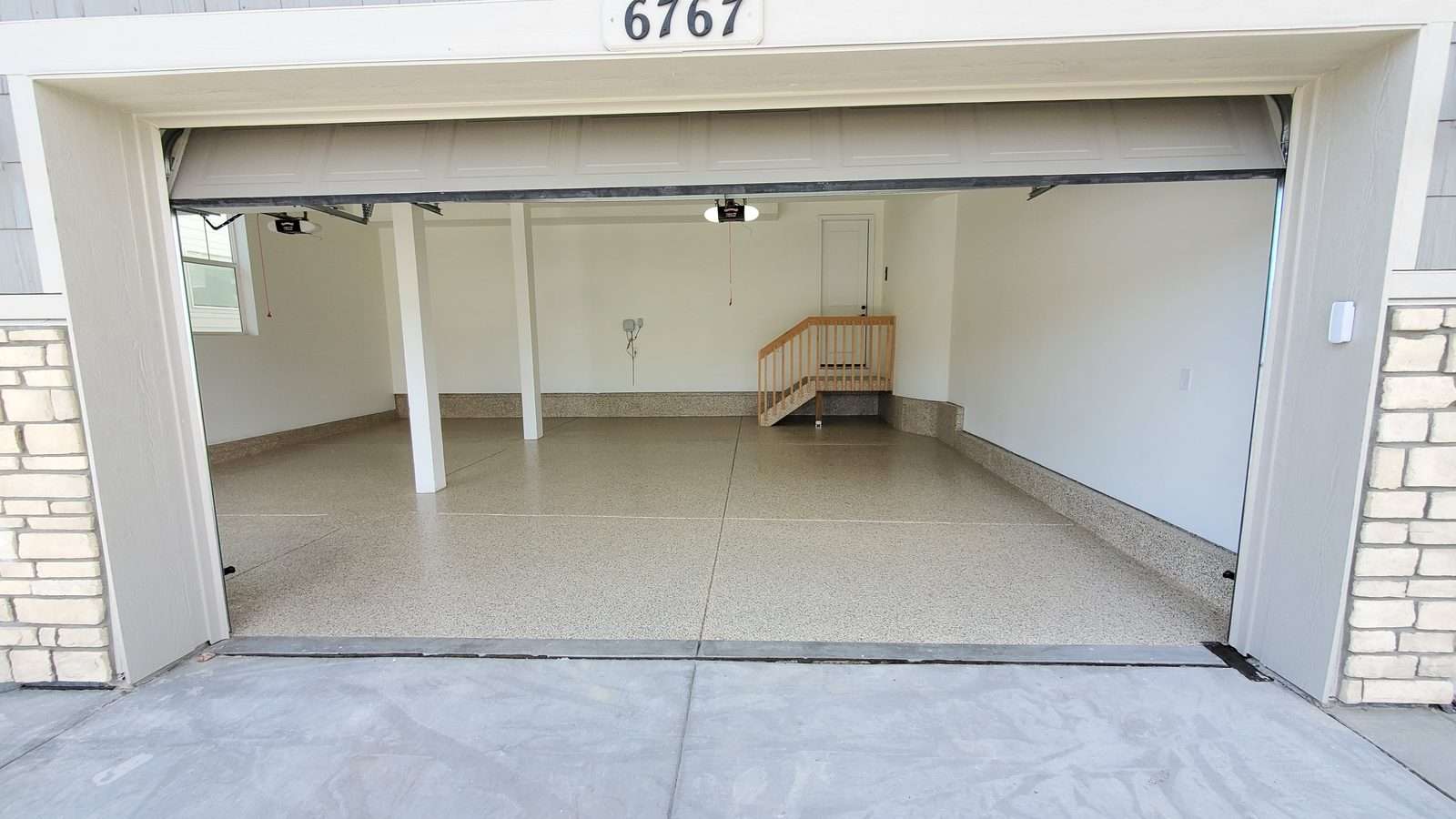
The story above mentions a slab that tested at 87 percent. That figure is the most useful number on a quote for epoxy garage floors, and it is the one homeowners are least often shown.
It comes from ASTM F2170, the standard test method for determining relative humidity in concrete floor slabs using in situ probes. Probes are drilled into the slab, sealed, and left to equilibrate, and what they report is the humidity inside the concrete rather than at its surface. That distinction is the whole point: a slab can be dry to the touch and still carry enough vapor to push a coating off from underneath.
What a given reading means is set by the product rather than by a universal pass mark. Coating systems publish the relative humidity they tolerate on their data sheets, and the same 87 percent that rules out one primer sits comfortably inside the range of a moisture-tolerant one. So the useful question is not whether the slab passed. It is what this reading rules out, and what it adds to the job.
Three outcomes follow. A low reading means the standard build goes down as quoted. A middling one usually means a moisture-tolerant primer, which is a line item rather than a redesign. A high one means a vapor-retarding layer underneath the system, which adds a step, a day and a cost. All three can be priced in advance, which is the reason the test happens before the number is written rather than after.
Ask for the figure and the method. Anyone who tested will have both. Epoxy garage floors that fail from below almost always trace back to a slab nobody measured. The same test governs every system on our garage floor coatings page.
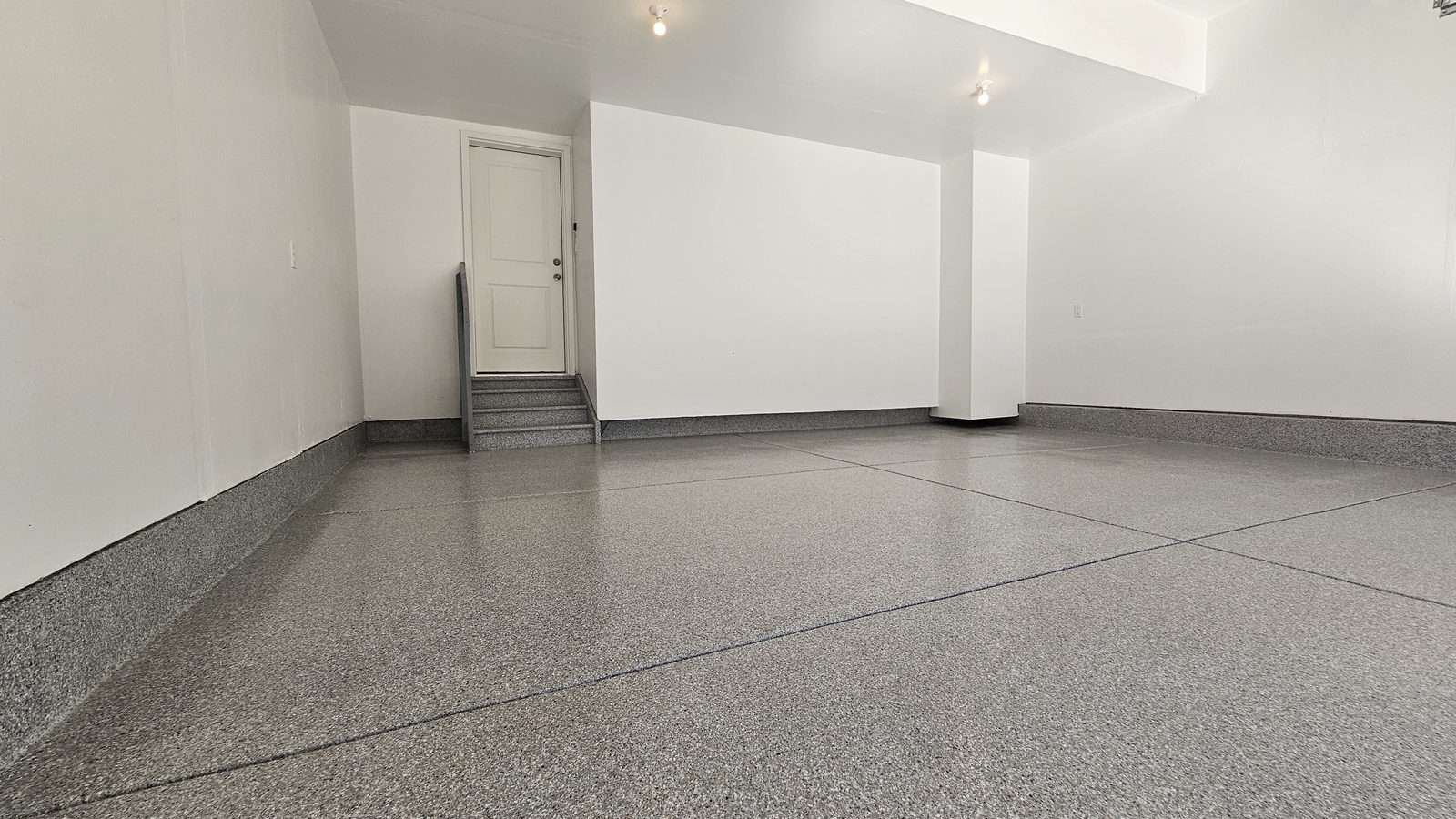
The first thing this page says is that an oil stain wiped off the surface darkens again within weeks. That is worth explaining, because it is the clearest everyday evidence of what a garage slab actually is.
Concrete is porous. Oil, transmission fluid and brake cleaner do not sit on top of it, they wick into it, and they keep migrating for years afterwards. Wiping the surface removes the part you can see and leaves the reservoir underneath, which is why the mark reappears as residue works its way back up. That same reservoir is what a coating has to bond through.
This is why degreasing is a separate step from grinding rather than part of it. Grinding opens the pores and takes off the weak surface layer, but a diamond grinder passing over a saturated patch can drive contamination deeper as easily as lift it out. Contaminated areas get treated chemically first, then ground, then checked again, because a clean-looking profile over an oily slab is exactly the condition that produces a blister a year later.
Two things follow for anyone comparing quotes on epoxy garage floors. A walkthrough should name the stained areas rather than pricing the floor as one uniform surface. And heavily saturated concrete sometimes cannot be rescued at the surface at all, where the honest answer is to cut out and replace that section instead of coating over it and hoping, which puts the job into concrete repair before any coating is specified.
It is the least glamorous part of the job, and it is the part that most often decides whether epoxy garage floors stay down or lift.
EvrStep Epoxy Coatings serves homeowners throughout Parker and the surrounding Douglas County areas, installing epoxy garage floors and polyaspartic systems directly at residential properties. From Stonegate to Castle Rock, the team reaches Parker-area homeowners via I-25, E-470, and Parker Road, covering neighborhoods including The Pinery and Meridian. EvrStep Epoxy Coatings completes most epoxy garage floors in a single day, and sets the return-to-service dates from the slab temperature measured on the day.
Service Area Coverage
Installation appointments typically begin early morning to maximize cure time, with surface preparation, moisture barrier application, and topcoat completed before evening.
EvrStep Epoxy Coatings uses a multi-layer preparation system that addresses Colorado’s freeze-thaw cycles and moisture migration. Durability depends on proper concrete profiling and climate-specific curing protocols.
EvrStep Epoxy Coatings builds floors to handle Parker’s temperature swings. Concrete gets diamond-ground, not acid-etched. That matters here. Moisture vapor testing happens before any coating touches the slab, because Colorado’s dry climate creates deceptive readings. The base coat goes down thicker than standard applications. Flake broadcast density gets adjusted for the final texture clients actually want to walk on. EvrStep Epoxy Coatings cures each layer against the ambient temperature on the day rather than assuming the manufacturer’s minimums.
Professional epoxy installation delivers bonded, uniform coatings through surface preparation and controlled application that DIY kits cannot replicate. Durability depends on concrete profiling depth and moisture testing before any coating touches the floor.
Box store kits skip the preparation that determines whether epoxy actually bonds. Concrete needs diamond grinding to open the pores. It needs moisture testing to confirm the slab won’t push vapor through the coating in six months. EvrStep Epoxy Coatings profiles every Parker garage floor to the correct depth before mixing a single batch. DIY instructions say “clean and etch.” That removes surface dirt. It does not create mechanical bond. Coatings peel at the edges first, then lift in sheets once traffic breaks the seal. We have pulled up failed DIY jobs where the epoxy came off in one piece because it never grabbed the concrete.
EvrStep Epoxy Coatings controls mix ratios, application temperature, and cure time in ways a homeowner cannot match with a roller and a weekend. The coating either penetrates or it sits on top. There is no middle outcome.
Surface preparation determines epoxy adhesion and longevity. Concrete must be mechanically profiled by grinding rather than acid etching, with all contaminants removed and moisture levels verified below acceptable thresholds.
Epoxy fails when it bonds to dirt instead of concrete. The floor needs mechanical profiling to open the pores, which means grinding or diamond abrading the surface until it feels like 80-grit sandpaper. Acid etching works for light prep, but it leaves residue that blocks adhesion if not neutralized and rinsed completely. Oil stains penetrate deep. A degreaser that sits on the surface does nothing.
Contractors who skip moisture testing in the Parker area learn this the hard way during spring. The slab looks fine in January. By April, sections are peeling. Preparation takes longer than application, but it determines whether the floor lasts two years or twenty.
Epoxy requires substrate temperatures between 50 and 90 degrees during application and curing. Colorado’s temperature swings can delay installation windows, particularly in unheated garages during spring and fall transitions.
Concrete temperature matters more than air temperature. The slab needs to stay within the curing range for at least 24 hours after application. Colorado garages cool fast overnight, even when daytime temps look perfect. Spring mornings in Parker can drop below threshold while afternoons spike above it. Professionals measure slab temperature directly before starting. Heating the space artificially works, but it has to run continuously through the cure window. Winter installations happen, but they require controlled conditions most homeowners don’t maintain.
Epoxy floors require routine sweeping, occasional mopping with pH-neutral cleaners, and immediate spill cleanup to maintain appearance. Longevity depends on avoiding abrasive tools and reapplying topcoats when surface gloss diminishes.
Dust and grit act like sandpaper on epoxy surfaces. Daily sweeping or dust mopping removes particles before they get ground into the coating by tires or foot traffic. For deeper cleaning, a soft mop with warm water and a pH-neutral cleaner works without degrading the finish. Avoid ammonia-based products or citrus degreasers. They break down the resin over time. Spills from oil, antifreeze, or battery acid should be wiped up within hours, not days. The coating resists these substances, but prolonged exposure can dull the surface or create discoloration that becomes permanent.
Topcoat reapplication every few years restores gloss and adds a fresh protective layer. Colorado’s temperature swings and UV exposure through garage windows accelerate wear on high-traffic zones near entry doors. A simple maintenance routine prevents the need for costly resurfacing.