
A garage floor coating can look sound at installation and still delaminate within two years if moisture vapor rises through the concrete slab, and most contractors only test for moisture when visible problems appear, not before the coating goes down. The adhesion failure shows up as bubbling or peeling in high-traffic zones, and by then the floor needs to be ground off and reinstalled from scratch. EvrStep Epoxy Coatings installs polyaspartic garage coatings in Parker with a moisture vapor barrier base coat applied to every floor as standard practice, protecting the investment now and for years down the road.
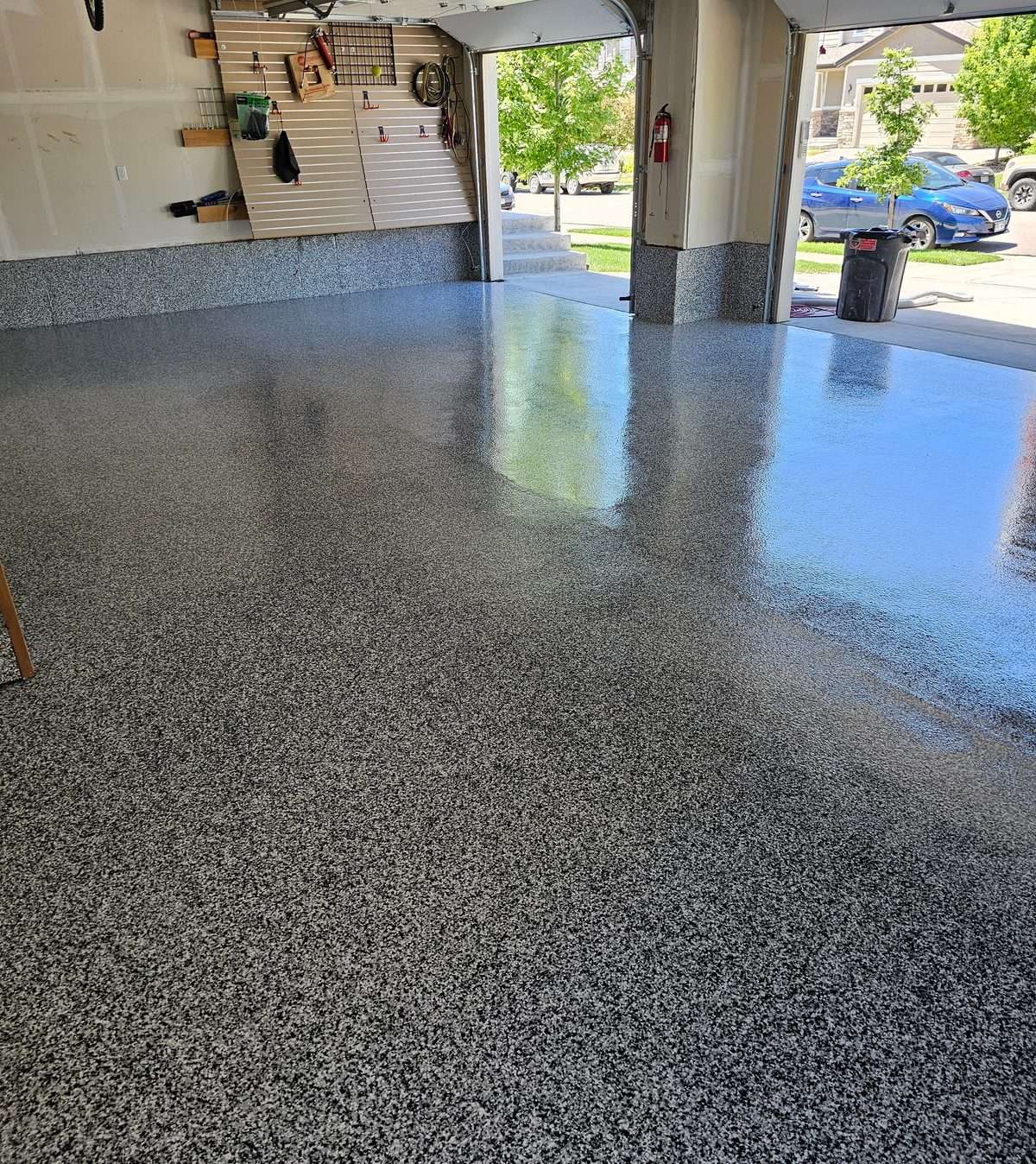
Polyaspartic garage coatings that hold up through Colorado winters require installers with documented prep standards and warranty terms you can actually read. EvrStep Epoxy Coatings brings mechanical surface preparation protocols, owner-level accountability, and cure timelines that minimize disruption for Parker residents.
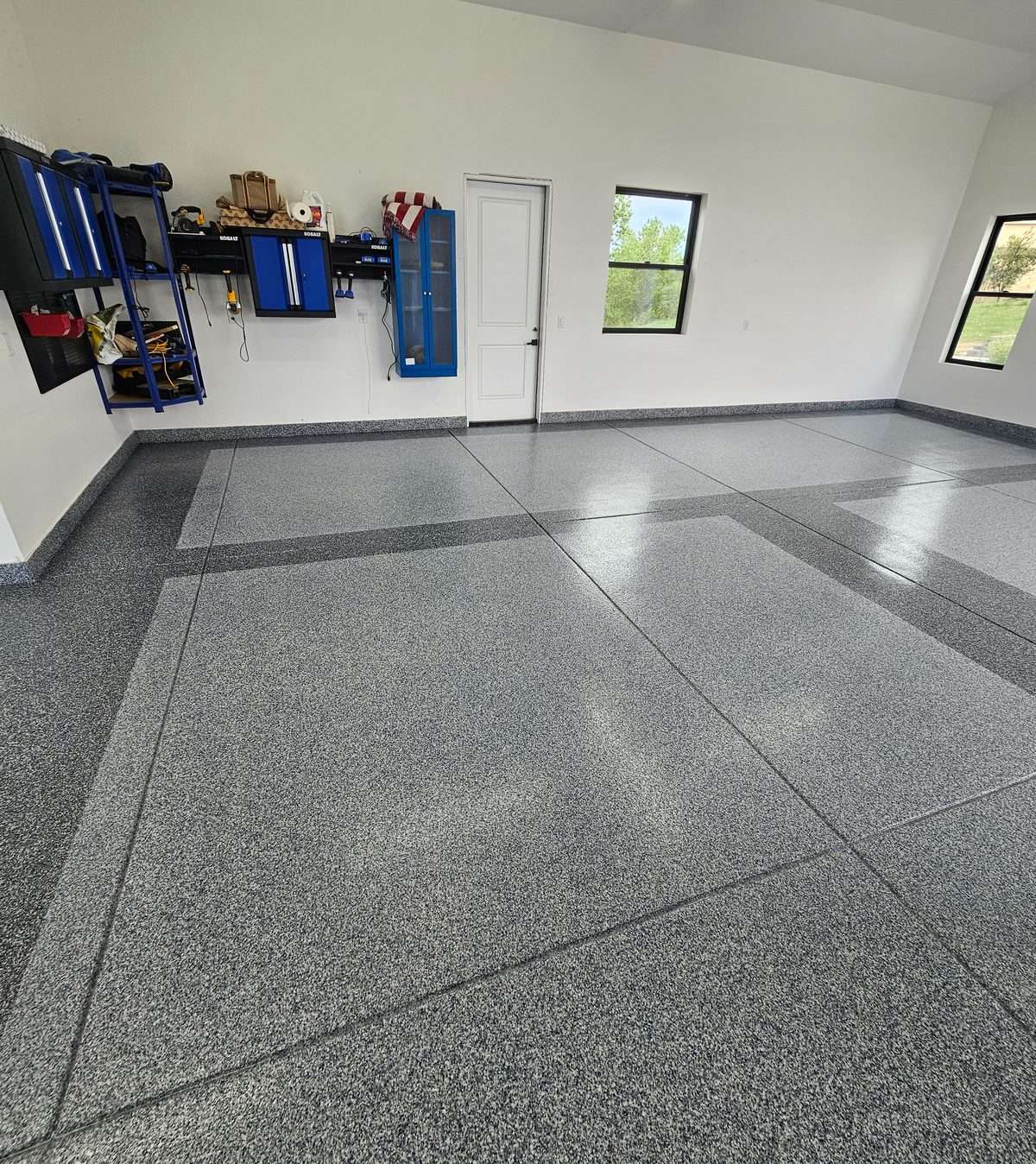
If you have ever watched a polyaspartic garage coatings installer skip the moisture probe and go straight to grinding, you already know where the callback comes from. The slab looks dry, the homeowner wants it done, and nobody runs the test that would have shown vapor pressure sitting just below the surface waiting to lift the new layer within eighteen months.
Audrey came to us needing the timeline moved up without cutting corners on prep. We ran moisture diagnostics, installed the MVB base layer, and delivered polyaspartic garage coatings that allowed vehicle traffic within forty-eight hours while protecting against the subslab conditions that most one-day promises ignore completely.
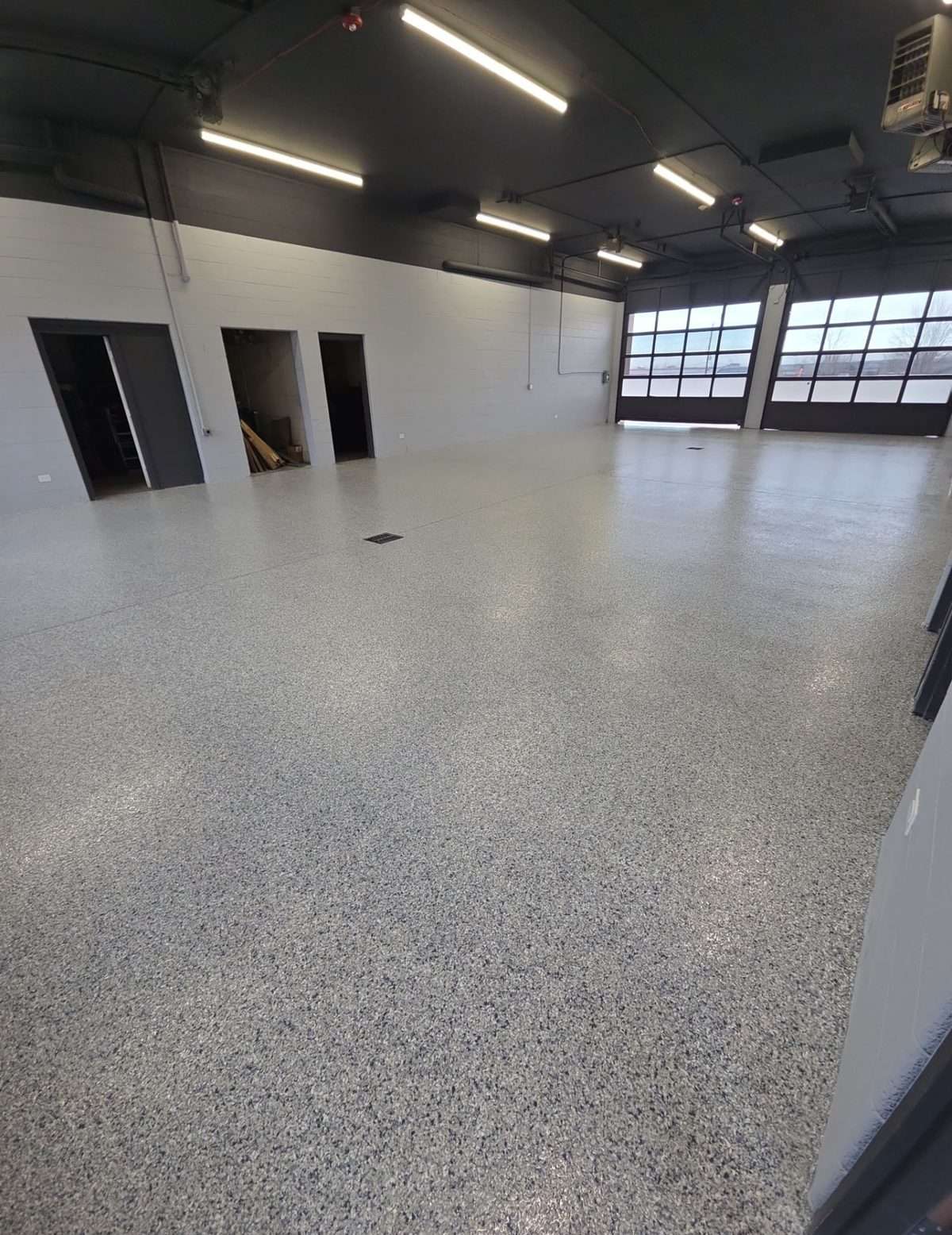
The three-stage build separates polyaspartic garage coatings that hold from those that fail within two years. Surface profile depth, structural crack treatment, and UV-stable topcoat chemistry determine whether the system survives Parker’s freeze-thaw cycles and altitude exposure or delaminates at the threshold.
We grind every slab to ICRI CSP-2 using 30-grit metal bond tooling and HEPA extraction, removing laitance and opening the pore structure for mechanical adhesion.
Cracks wider than hairline get routed, filled with rapid-set polyurea, and sanded flush. Bobbi came to us with a heavily cracked floor; the repair work brought the cracked areas back to a flush, sound surface.
The polyurea base bonds directly to prepared concrete, full vinyl flake broadcast follows, then aliphatic polyaspartic topcoat locks UV stability. Troy needed scheduling flexibility; we walked him through each layer as it went down, and the build held through two winters without a single callback.
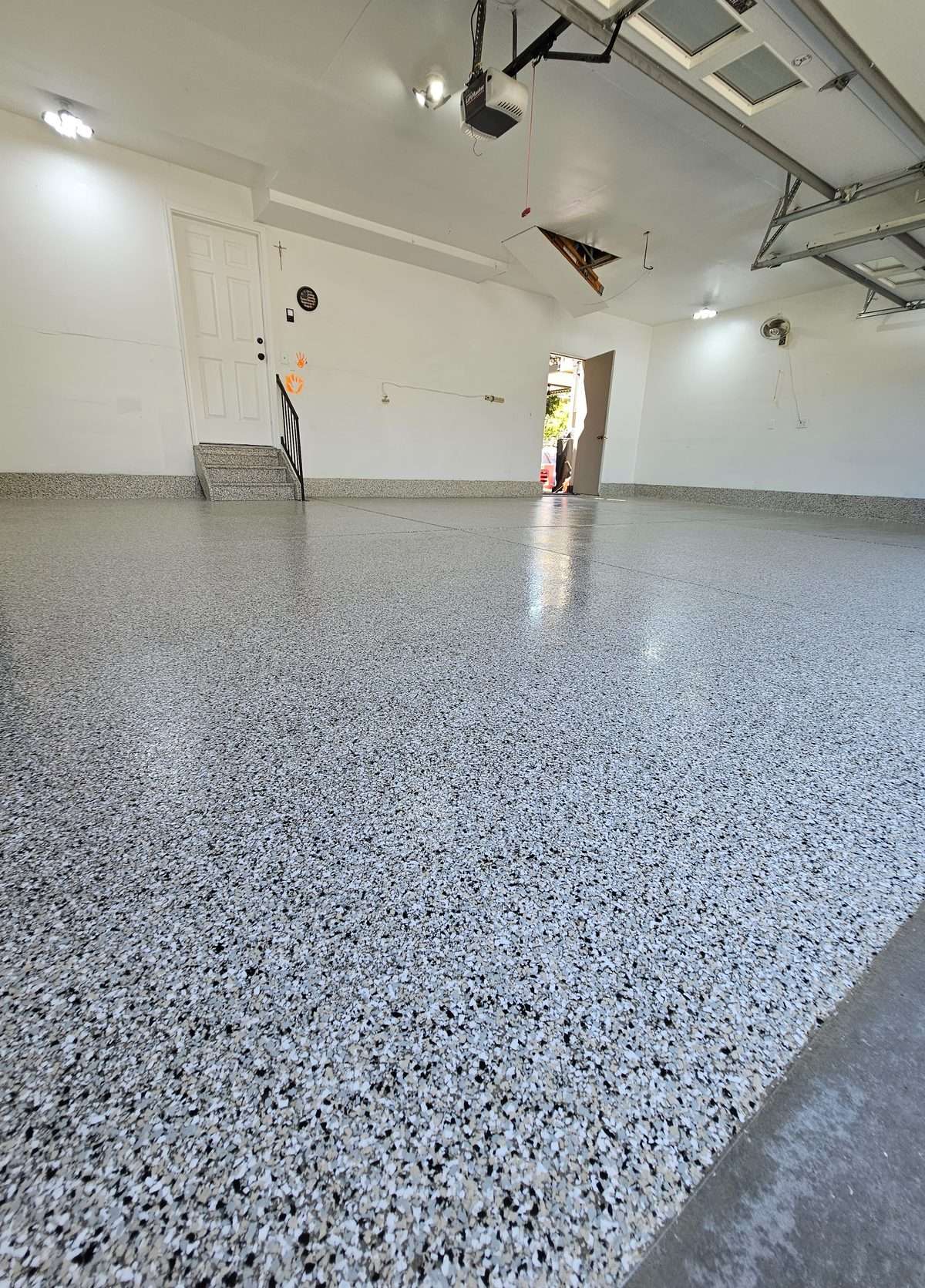
Polyaspartic garage coatings fail when moisture diagnostics are skipped or when application conditions do not match the stress profile the floor will actually see. The substrate preparation and cure environment determine longevity far more than the brand name on the product data sheet.
Substrate moisture is the variable. A coating applied over concrete that tests above the limit its data sheet allows, commonly around 75 percent relative humidity, will delaminate regardless of topcoat quality. George needed his floor completed before his move-in date, so we ran ASTM F2170 probes, installed a moisture vapor barrier base coat, and delivered a finish that held through two Colorado winters without a single lift.
Full broadcast to rejection adds abrasion resistance and hides minor substrate imperfections that telegraph through thin coats. The vinyl flake layer also helps dissipate point loads from dropped tools or tire contact. David came to us with foam expansion joints, creating an uneven surface in his mountain garage. We flattened the substrate, applied a full flake system, and the finished floor absorbed the irregularities while delivering a surface that has held up under heavy use.
Cure temperature and DFT matter more than brand. Systems cured below 70°F or applied too thin soften under load when slab temps hit 120°F in July sun exposure. Most two-car garages in Parker and Denver run $2500 to $3500 installed, depending on prep requirements and system build. Thicker topcoat applications at proper cure temps resist tire marking, where thinner budget systems fail within the first season.
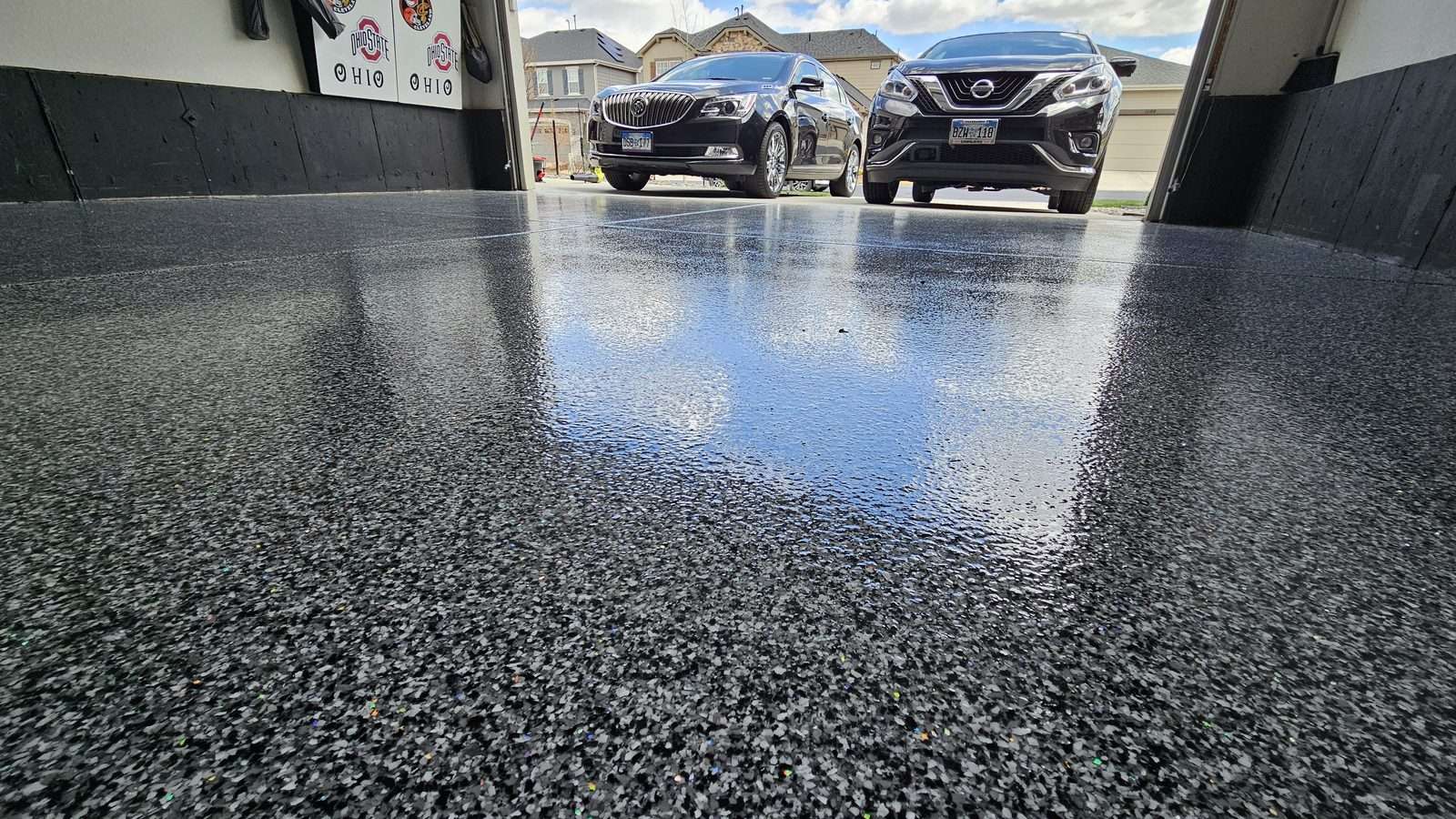
This page uses the abbreviation DFT once and moves on. It stands for dry film thickness, it is measured in mils, and a mil is one thousandth of an inch. It is also the number that separates two quotes that otherwise look identical.
Thickness is not something you can specify by counting coats. Two installers can both promise a base coat, a flake broadcast and a clear topcoat, and finish at very different builds, because how much material goes down per square foot is a choice made at the bucket rather than in the proposal. A floor can be given three coats and still be thin.
The honest way to ask is by coverage rate. Manufacturers publish consumption figures on the data sheet for a floor coating, so a quote that names the product and the coverage rate has told you the build. One that says only how many coats has not. If a number is quoted, it is worth checking whether it describes the whole system or just the topcoat, because those are very different figures.
Thickness is doing real work here. It carries the abrasion the floor takes, it holds the flake, and it is what resists the softening that shows up as hot tire pickup in July. A thin build is also why a coating telegraphs every imperfection in the slab underneath, which is the effect a full flake broadcast is partly there to hide.
None of this makes a thicker floor automatically better. It makes the number worth seeing. Polyaspartic garage coatings quoted without a thickness or a coverage rate are quoted on trust, and trust is the hardest thing to compare between two proposals. The same question is worth asking about epoxy garage floors, where the base coat carries most of the build.
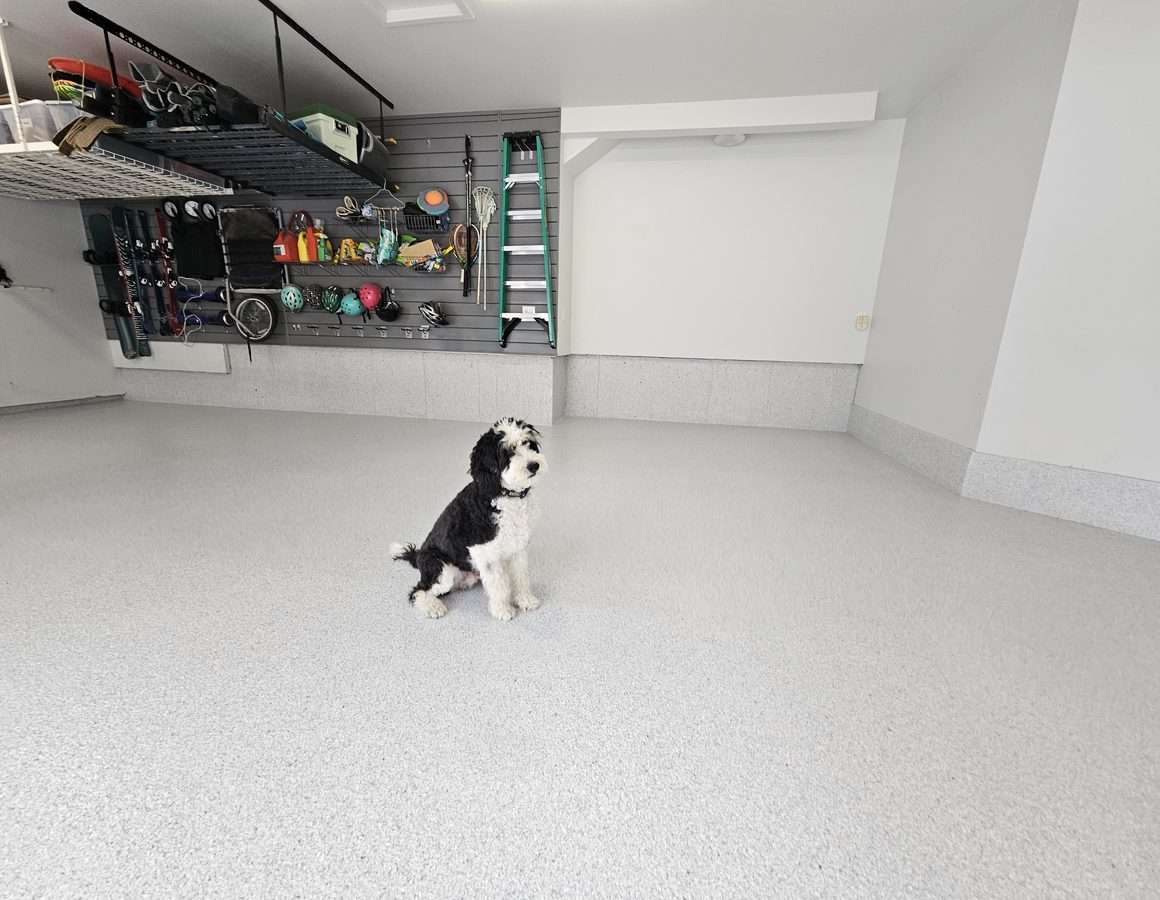
This page argues that preparation matters more than the product on the label. That is true, and it leaves a fair question unanswered: prep is finished and buried before the coating goes down, so how would a homeowner ever know it was done properly?
There is a window, and it is the middle of the day. Between the grinding and the first coat, the slab is exposed and everything worth checking is visible. It is worth walking out and looking.
A properly ground floor is uniformly dull across the whole surface, including the corners and the strip along the walls where a machine is awkward to run. Shiny patches mean the old surface is still there. The concrete should feel like fine sandpaper rather than smooth, because the profile is what the coating grips. Any area that was darkened by oil should have been treated before grinding rather than simply ground over, and the crew should be able to say which spots those were.
Dust is the other tell. Grinding concrete releases silica, so a vacuum should be attached to the machine rather than standing in the corner, and the air should stay clear. A garage full of haze means containment is not working, and dust that stays airborne eventually settles onto the surface being coated.
If a bond ever has to be settled with evidence rather than opinion, there is a published method for it: ASTM D7234 covers pull-off adhesion strength of coatings on concrete, and it is the test a dispute would come down to. Most jobs never need it, which is exactly why the visible hour matters so much.
Ask two questions while you are standing there: what the moisture reading was, and what profile they ground to. Anyone doing the work properly answers both without looking anything up. Polyaspartic garage coatings are only as good as the hour before they go down. The rest of our garage floor coatings work follows the same sequence.
EvrStep Epoxy Coatings serves homeowners throughout Parker and the surrounding Douglas County areas, installing polyaspartic garage coatings directly at residential properties. From Stonegate to Castle Rock, the team reaches Parker-area garages via I-25, E-470, and Parker Road, covering neighborhoods across the Front Range corridor. EvrStep Epoxy Coatings completes moisture testing, surface preparation, and full polyaspartic garage coatings installation within a single-day timeline, with 24-hour foot traffic and 48-hour vehicle return as standard.
Coverage Footprint
The installation crew arrives with commercial-grade grinders, HEPA extraction, and all coating materials, completing the full process from diamond grinding through topcoat application in one scheduled visit.
Polyaspartic garage coatings cure faster and tolerate wider temperature ranges than traditional epoxy, allowing year-round installation. Performance depends on proper surface preparation and moisture testing before application.
EvrStep Epoxy Coatings uses polyaspartic formulations that cure in hours, not days. Colorado’s temperature swings don’t stop the work. Traditional epoxy fails below 50 degrees or above 90. Polyaspartic doesn’t. The Parker climate demands flexibility. EvrStep Epoxy Coatings preps the concrete with diamond grinding, not acid etching. That matters when the slab has existing sealers or oil stains. Most coating failures trace back to adhesion problems, not product quality.
Polyaspartic garage coatings maintain flexibility across extreme temperature ranges, resisting cracking during freeze-thaw cycles. Performance depends on proper surface preparation and cure conditions before the first winter exposure.
Polyaspartic formulations flex with concrete movement during temperature swings. Epoxy becomes brittle in cold conditions and cracks when the slab contracts. Polyaspartic stays pliable down to subzero temperatures, which matters when your garage drops to fifteen degrees overnight and climbs to fifty by afternoon. That temperature differential causes concrete to expand and contract. A rigid coating fractures at the bond line. A flexible one moves with the substrate. The chemistry difference is not subtle. Polyaspartic polymers have longer molecular chains that allow movement without breaking adhesion. Colorado garages see this cycle dozens of times each winter, and coatings either survive or they don’t.
Surface moisture is the actual threat during installation. If the concrete holds residual water from snow melt and freezes before the coating fully bonds, delamination happens within weeks. Proper moisture testing and dry substrate conditions matter more than the coating’s inherent flexibility.
Polyaspartic coatings cure faster and tolerate wider temperature ranges during application than epoxy, making them more reliable for Colorado’s unpredictable weather. They also resist UV yellowing and abrasion better over time.
Epoxy requires narrow temperature windows and extended cure times that Colorado weather rarely cooperates with. A cold snap during curing can ruin adhesion. Polyaspartic formulations cure in hours, not days, and tolerate application in temperatures as low as 20 degrees. That flexibility matters when you’re working in Parker garages that swing from freezing mornings to warm afternoons. EvrStep Epoxy Coatings switched to polyaspartic systems after watching too many epoxy jobs fail because homeowners opened garage doors too early or temperatures dropped overnight.
The cost difference between the two systems is modest. Polyaspartic installations from EvrStep Epoxy Coatings cost slightly more upfront but eliminate the multi-day wait and reduce the risk of application failures tied to weather. Foot traffic resumes about 24 hours after the topcoat goes down, and vehicles about 48 hours after, on a slab sitting at a normal working temperature.
Failures in polyaspartic garage coatings trace back to moisture in concrete, incomplete oil removal, or skipped acid etching. Proper surface prep requires testing concrete moisture levels and grinding away contaminants before application.
Moisture trapped in concrete causes delamination within months. Oil stains that look clean still leave residue that prevents adhesion. Skipping the grind means the coating sits on dust instead of bonding to aggregate. Colorado’s dry climate fools people into assuming concrete is ready. It’s not. A moisture meter catches what eyes miss. Grinding opens the pore structure. Acid etching alone doesn’t cut through years of car drippings. The coating only performs when it locks into clean, profiled concrete.
Polyaspartic garage floors require minimal maintenance beyond regular sweeping and occasional mopping with pH-neutral cleaners. Avoid abrasive scrubbing tools and acidic chemicals that can dull the finish over time.
Polyaspartic coatings resist most household chemicals, hot tire pickup, and oil stains without special treatment. Sweep or blow out debris weekly to prevent grit from scratching the surface when vehicles drive over it. Mop with warm water and a mild, pH-neutral cleaner when needed. Skip the harsh degreasers. The coating’s chemical resistance handles automotive fluids well, but prolonged exposure to battery acid or paint thinner still warrants quick cleanup. Colorado winters bring road salt and de-icing chemicals into garages, and while polyaspartic tolerates these better than bare concrete, rinsing them off prevents buildup that can create a hazy film.
Resealing is not necessary. The coating does not wear through like wax or require annual reapplication. Avoid dragging metal tools or sharp objects across the floor, and place mats under heavy equipment if concerned about concentrated weight. The finish stays intact for years with basic care.