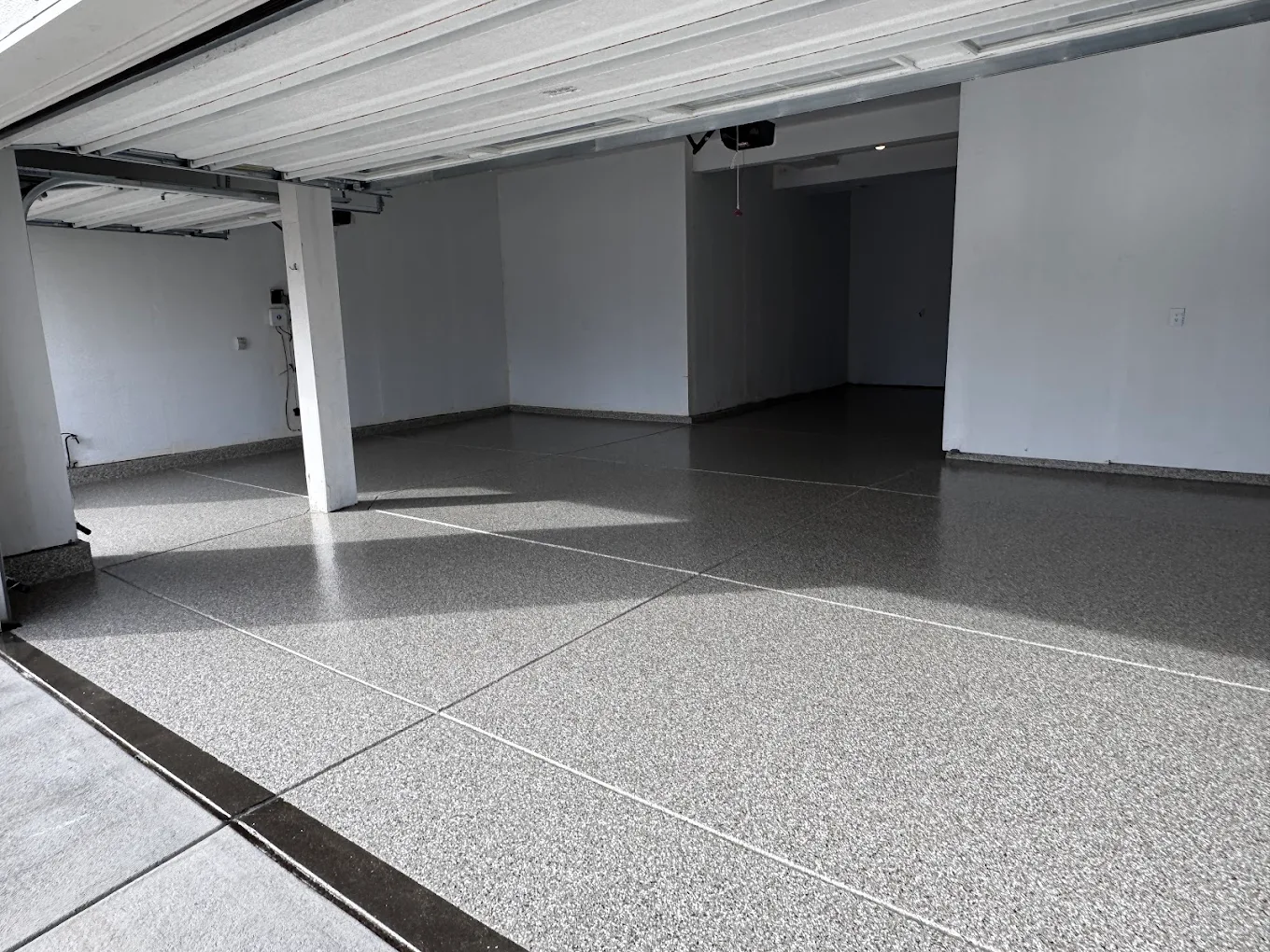
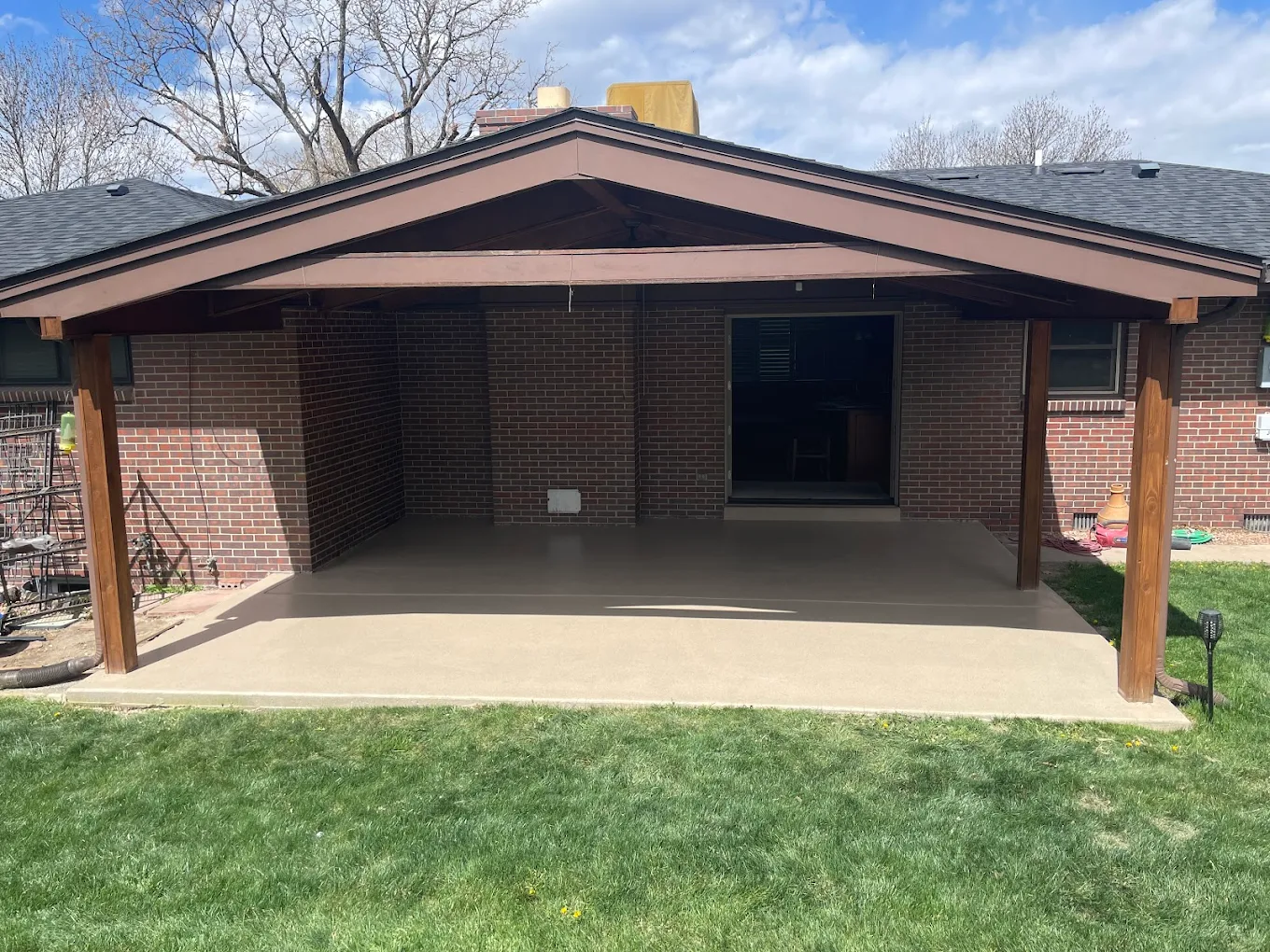
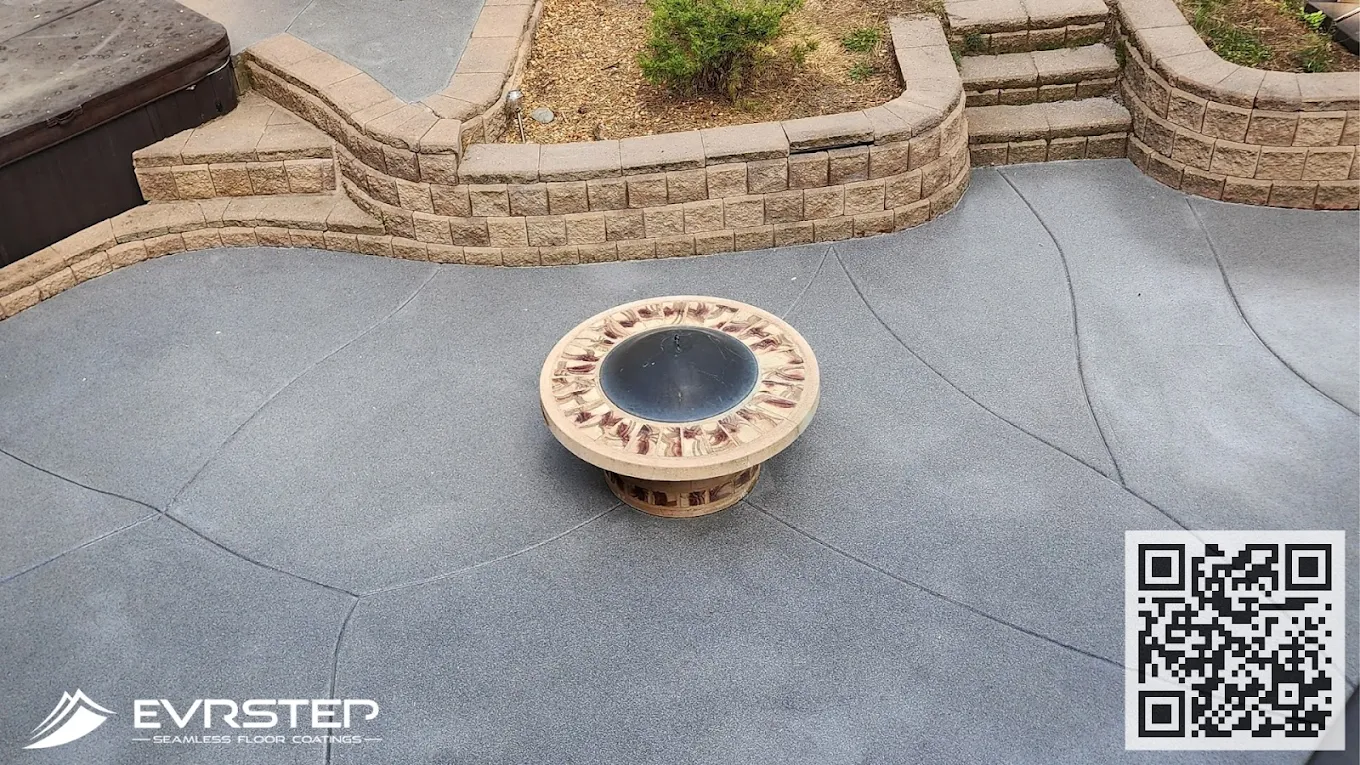
When deciding between exterior epoxy and bare or sealed concrete for outdoor spaces in Parker, Colorado, the local climate and application must be factored in. Bare or stained concrete is ideal for most uncovered outdoor areas because standard epoxy is not UV stable and will yellow or peel.
However, if you are coating a shaded patio, a driveway, or a functional workspace, an exterior‑rated coating system such as epoxy or polyaspartic provides superior protection against oil stains, road salts, and freeze‑thaw cracking.
- Pros: Highly breathable, meaning water vapor can escape without causing the material to bubble or peel. It maintains a natural, slip‑resistant surface.
- Cons: Porous, making it highly susceptible to absorption of grease, lawn fertilizers, and pool chemicals.
- Maintenance: Requires regular pressure washing and the application of a penetrating acrylic or siloxane sealer every 1–3 years.
- Pros: Unmatched chemical resistance and durability. It’s easy to wipe clean, keeps dust down, and can be customized with decorative flakes or anti‑slip textures.
- Cons: Standard indoor epoxy will degrade, yellow, and chalk under the harsh Colorado sun. It is also rigid and can be prone to peeling if moisture becomes trapped underneath.
- UV Stability: Will not yellow or fade in direct, high‑elevation sunlight.
- Flexibility: Expands and contracts with the concrete during Colorado’s temperature swings.
- Cure Time: Dries much faster than epoxy, meaning your patio or driveway can be ready for use in as little as 24 hours.
- Sun Exposure: Is the area fully exposed to the sun or is it covered/shaded?
- Primary Use: What is the primary use of the space (e.g., driveway, pool deck, patio)?
- Current Condition: What is the current condition of the concrete?
In Parker, UV and freeze‑thaw cycles make bare concrete vulnerable, while exterior‑rated epoxy systems can seal, protect, and last longer when properly installed and maintained.
If you’ve ever watched a driveway crack after a harsh winter, you know the frustration of a surface that can’t keep up with Colorado’s weather. The question isn’t just which material looks better, but which one survives the sun, snow, and salt without costly repairs.
In this post we’ll compare the real‑world durability of exterior epoxy versus concrete, highlight common mistakes, and give you a clear plan for choosing the right system for your Parker home.
Why Bare Concrete Fails in Freeze‑Thaw Cycles While Epoxy Flexes
Parker’s winter swings can push concrete beyond its tensile limits, especially when water infiltrates pores and freezes. The expansion creates micro‑cracks that grow with each cycle, leading to spalling and uneven surfaces.
Epoxy, when applied correctly, forms a flexible, crack‑bridging membrane that moves with the slab. This elasticity absorbs the stresses that would otherwise break the concrete, keeping the surface intact longer.
A quick comparison of how each material reacts to freeze‑thaw stress
| Material | Moisture Penetration | Flexibility | Typical Lifespan |
|---|---|---|---|
| Bare Concrete | High | Low | 15‑20 years |
| Standard Epoxy | Medium | Low | 5‑10 years |
| Exterior‑Rated Epoxy | Low | Medium | 10‑20 years |
Key Flex Benefits
- Elastic Bond: The cured epoxy adheres strongly yet accommodates slight movement, reducing stress concentration on the slab.
- Moisture Barrier: A sealed film blocks water ingress, preventing the freeze‑thaw expansion that cracks plain concrete.
- Chemical Shield: Epoxy resists road salts and de‑icing chemicals that accelerate concrete degradation.
- Surface Uniformity: The coating creates a smooth, even finish that reduces water pooling and freeze‑thaw pressure points.
- Repair Simplicity: Small chips can be patched without full slab removal, unlike cracked concrete which often needs extensive grinding.
In practice, homeowners who upgrade to an exterior‑rated epoxy system notice fewer cracks after the first winter and enjoy a smoother, easier‑to‑clean surface. The flexibility of the coating is the hidden advantage that plain concrete simply cannot match in Parker’s climate.
The Surface Prep Mistake That Makes Exterior Epoxy Delaminate Early
Even the best epoxy will peel if the concrete isn’t prepared to the right profile. Many contractors skip the recommended shot‑blasting step, leaving a smooth surface that fails the pull‑off adhesion test.
In Parker, humidity can linger in the slab after a rain, and without proper moisture testing the epoxy can trap vapor, creating bubbles that pop and separate the coating.
Preparation Pitfalls
- Profile Deficiency: Failing to achieve CSP 2‑3 leaves insufficient texture for mechanical interlock, reducing bond strength.
- Moisture Ignorance: Not measuring MVER before coating allows vapor to escape through the film, causing blistering.
- Contaminant Residue: Oil, grease, or curing compounds left on the slab act as release agents, leading to premature delamination.
- Temperature Mismatch: Applying epoxy when ambient temperature is below 50°F slows cure, weakening the film’s integrity.
- Improper Mixing: Inaccurate resin‑hardener ratios create soft spots that separate under traffic.
A disciplined prep routine, cleaning, profiling, moisture testing, and temperature control, eliminates the most common cause of early failure. When you follow these steps, the epoxy adheres like a second skin, even under Parker’s harsh winter conditions.
What Happens When UV Hits Standard Indoor Epoxy on Outdoor Concrete
Indoor epoxy formulations lack UV inhibitors, so when sunlight strikes the surface, the polymer chains break down. The result is a chalky, yellow film that loses its protective qualities within months.
In high‑altitude Parker, UV intensity is greater, accelerating the degradation and exposing the underlying concrete to moisture and chemicals.
UV Damage Effects
- Color Shift: Aromatic epoxy yellowing reduces aesthetic appeal and can hide surface cracks.
- Loss of Gloss: UV photons break surface bonds, causing a dull, matte finish that traps dirt.
- Reduced Hardness: Photodegradation softens the coating, making it more prone to abrasion and scratching.
- Increased Porosity: Cracked film allows water and salts to reach the concrete, leading to freeze‑thaw damage.
- Shortened Lifespan: Overall service life drops from a decade to a few years without UV‑stable additives.
Because of these mechanisms, most experts recommend a UV‑stable topcoat, such as an aliphatic polyurethane or polyaspartic, over standard indoor epoxy for any outdoor application in Parker.
Concrete Sealer vs Epoxy Coating: Which Actually Stops Water Penetration
A concrete sealer creates a thin film that slows water absorption but does not eliminate it. Water can still find micro‑paths through pores and eventually reach the slab, especially after repeated freeze‑thaw cycles.
Epoxy, by contrast, forms a thick, continuous barrier that blocks moisture entirely, provided the surface is properly prepared and the coating is applied at the correct thickness.
Sealer vs Epoxy
- Barrier Thickness: Sealers are typically less than 0.1 mm, while epoxy builds a 1‑3 mm film that resists vapor transmission.
- Adhesion Strength: Epoxy pull‑off values often exceed 300 psi, whereas sealers rely on surface tension and can peel under stress.
- Longevity: Sealers need re‑application every 2‑3 years; epoxy systems can last a decade or more with proper maintenance.
- Chemical Resistance: Epoxy resists salts and oils, while sealers may degrade when exposed to de‑icing chemicals.
- Installation Sensitivity: Epoxy demands strict temperature and humidity control; sealers are more forgiving but less protective.
For Parker homeowners who want a truly waterproof solution, an exterior‑rated epoxy system outperforms traditional sealers, especially in areas exposed to snow melt and road salt.
How Temperature Swings Expose the Weakness in Uncoated Concrete Slabs
Parker experiences temperature swings from below zero in winter to over 90°F in summer. Concrete expands and contracts with these changes, and without a flexible coating, the slab develops stress cracks.
These cracks become pathways for water, salts, and freeze‑thaw damage, accelerating the slab’s deterioration.
Thermal Stress Impacts
- Expansion Gaps: Uncoated slabs lack a flexible layer, so thermal expansion creates surface tension that cracks the concrete.
- Contraction Pull‑back: Rapid cooling contracts the slab, pulling on existing micro‑cracks and widening them.
- Moisture Entrapment: Cracks trap water, which freezes and expands, forcing the slab apart.
- Surface Spalling: Repeated freeze‑thaw cycles cause surface layers to flake off, exposing fresh concrete to the elements.
- Reduced Load Capacity: Cracked slabs lose structural integrity, making them unsafe for heavy vehicles or equipment.
Adding a flexible, moisture‑resistant epoxy coating mitigates these thermal stresses, keeping the slab intact and extending its service life in Parker’s variable climate.
The Traction Problem Most Homeowners Don’t Consider Until It Rains
A smooth epoxy finish looks great when dry, but when water or snow melts, the surface can become dangerously slick. Many homeowners overlook the need for slip‑resistance until a winter storm creates a safety hazard.
In Parker, where snow and ice are common, incorporating traction additives during installation is essential for both safety and code compliance.
Typical slip‑resistance values for common traction additives
| Additive | Dry COF | Wet COF | Typical Use |
|---|---|---|---|
| Quartz Broadcast | 0.45 | 0.55 | Patios and decks |
| Aluminum‑Oxide Grit | 0.48 | 0.60 | Driveways and ramps |
| Polymer Anti‑Slip | 0.43 | 0.50 | Pool decks |
Traction Solutions
- Quartz Broadcast: Adding fine quartz creates a micro‑texture that improves wet COF without compromising appearance.
- Aluminum‑Oxide Grit: This grit offers high slip resistance and resists wear from foot traffic and vehicle tires.
- Anti‑Slip Additives: Polymer‑based additives can be mixed into the topcoat to increase grip while maintaining a glossy finish.
- Designated Walkways: Applying a higher‑grit mix on steps and ramps ensures consistent traction where it matters most.
- Regular Maintenance: Cleaning debris and re‑applying a thin grit layer after heavy snow melt preserves slip resistance over time.
By planning for traction from the start, you avoid the costly retrofit of adding a separate anti‑slip overlay after a winter accident.
Why We Stopped Recommending Paint‑Grade Sealers for Driveways and Patios
Paint‑grade sealers are designed for indoor walls, not for the harsh outdoor environment of Parker’s driveways. They lack the durability, UV protection, and chemical resistance needed for high‑traffic areas.
Our field observations show that these sealers blister, peel, and lose color within a single season when exposed to salt, sun, and temperature swings.
Seal‑Grade Limitations
- UV Degradation: Paint‑grade formulas yellow quickly under Parker’s intense sunlight, compromising appearance and protection.
- Chemical Vulnerability: De‑icing salts and oil spills break down the sealer film, leading to premature wear.
- Insufficient Thickness: Thin films cannot bridge micro‑cracks, allowing water to infiltrate the concrete substrate.
- Limited Flexibility: Rigid sealers crack under freeze‑thaw movement, exposing the slab to further damage.
- Short Service Life: Homeowners typically replace paint‑grade sealers every 1‑2 years, increasing long‑term cost.
Switching to an exterior‑rated epoxy system eliminates these issues, delivering a durable, UV‑stable surface that stands up to Parker’s climate and traffic demands.
Choosing the Right Exterior Surface
We’ve walked through the key differences between bare concrete and exterior epoxy, highlighted preparation pitfalls, and shown how UV, temperature, and traction affect long‑term performance in Parker. The evidence points to a flexible, UV‑stable epoxy system as the most reliable choice for high‑traffic, sun‑exposed areas.
If you’re ready to protect your driveway, patio, or workspace from Colorado’s harsh winters and bright summers, consider an exterior‑rated epoxy coating from a qualified installer. Contact EvrStep Epoxy Coatings today to discuss a custom solution that meets your local climate and design goals.
Author
This article was written by the EvrStep Epoxy Coatings Editorial Team, experienced professionals serving Parker. Our team focuses on educating clients and providing valuable insights to help them make informed decisions.