
Enhance your space with polished concrete, a sleek and durable flooring solution that provides a smooth, glossy surface without the need for additional coatings. Designed for longevity and minimal maintenance, it suits offices, retail spaces, warehouses, restaurants, and educational facilities.
Looking for a flooring solution that combines style, durability, and low maintenance? EvrStep’s polished concrete delivers a high-gloss, reflective surface that enhances natural light while providing a tough, wear-resistant finish. Unlike traditional flooring options, the finished slab needs no additional coatings, making it a cost-effective and eco-friendly choice.
Achieve a mirror-like shine with a surface that resists wear, stains, and foot traffic over time.
No wax, no coatings, just a sleek, long-lasting finish that’s easy to clean and maintain.
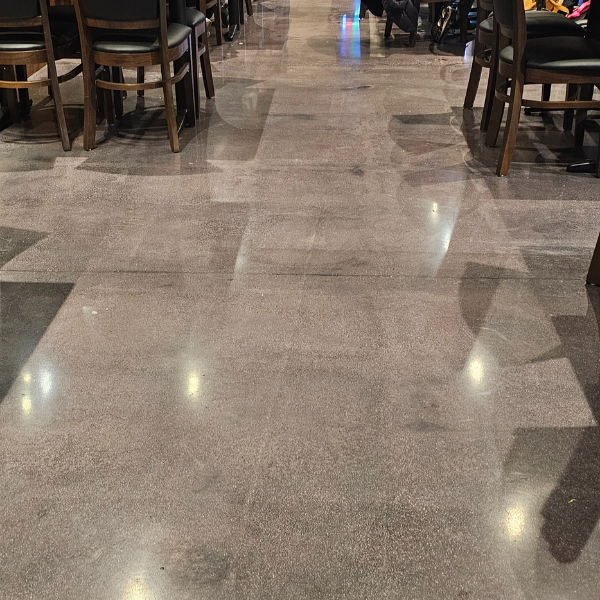
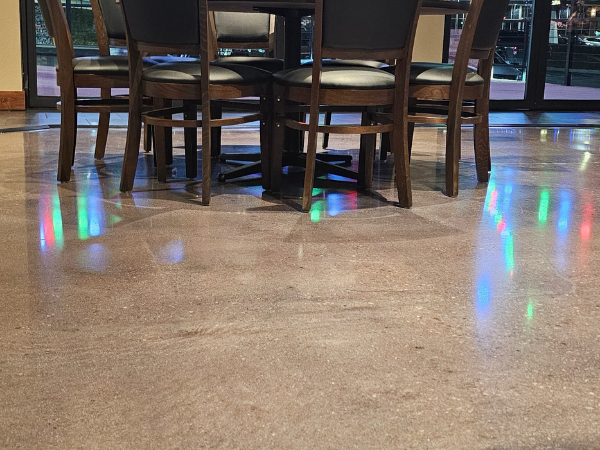
Ideal for modern workspaces and high-traffic environments, polished concrete offers superior performance with a contemporary aesthetic.
EvrStep’s polished concrete is designed for spaces that demand both style and strength. Whether in a bustling retail store, a corporate office, or a high-traffic warehouse, the same floor delivers the performance without sacrificing aesthetics.
Imagine a floor that reflects light beautifully while standing up to heavy foot traffic and daily use. With EvrStep, you get more than just a polished surface, you get a flooring solution built to last.
EvrStep elevates your space with timeless durability and effortless elegance. Upgrade your flooring with a high-performance solution that’s as functional as it is visually stunning.
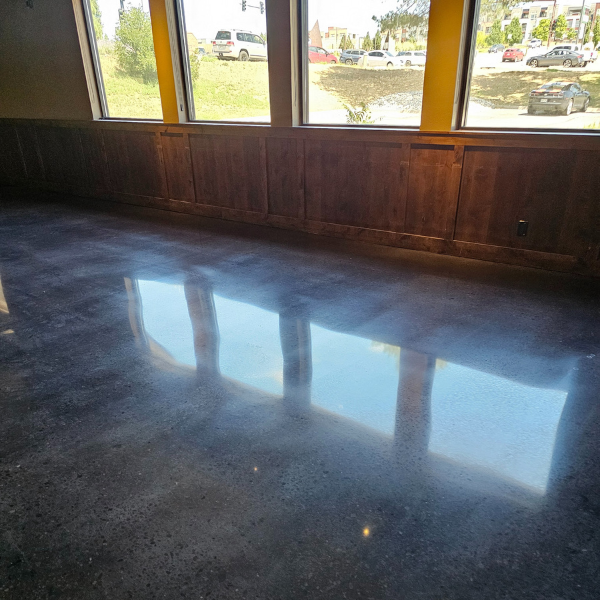
Gloss on a polished floor is not a coating. It is refinement. The slab goes through a sequence of diamond tooling, coarse metal-bond segments first to open the surface and take out the high spots, then progressively finer resin-bond pads that close it back up. Each step is only there to remove the scratch pattern the step before it left.
That is why the sequence cannot be shortened. Jump from a coarse grit straight to a fine one and the fine pads polish the tops of the deeper scratches without ever reaching the bottoms. The floor looks acceptable on handover day under diffuse light, then reads hazy the first time low afternoon sun crosses it, because the scratch pattern is still down there scattering light.
The practical consequence for a buyer is that the grit schedule is the specification. Ask what the final grit is and how many steps come before it. A floor finished at a higher grit costs more in labor and looks deeper, and a floor that skipped steps cannot be rescued by a topical gloss later without becoming something other than a polished slab. Where a full grit schedule is not the right spend, grind and seal stops the sequence early on purpose and puts the shine in a sealer instead.
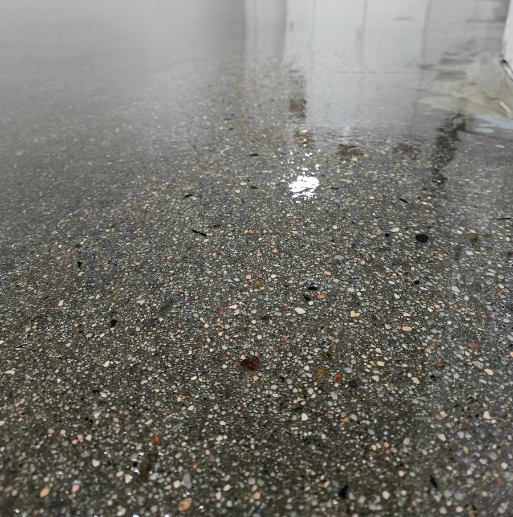

Achieve a sleek, high-gloss surface that enhances natural lighting and gives your space a modern appeal.
Polished concrete is designed for longevity, resisting scratches, stains, and abrasions in high-traffic environments.
With no need for wax or coatings, polished concrete offers easy cleaning and upkeep, reducing long-term maintenance costs.
A sealed, non-porous surface protects against spills and stains, making it ideal for restaurants, offices, and retail spaces.
By eliminating the need for additional coatings and frequent upkeep, polished concrete reduces flooring expenses over time.
An eco-friendly option that improves indoor air quality and minimizes material waste by utilizing existing concrete.
Grinding into a slab exposes what is in it, and how far down you go decides the look. Take off only the surface paste and you get a cream finish with almost no stone showing. Go deeper and you reach salt and pepper, small flecks of sand and fine aggregate. Deeper still and the large stone comes up, which is the aggregate-exposed look people usually have in mind from photographs.
The catch is that the slab decides how evenly that happens. A floor poured in sections on different days can hold different amounts of cream, so the same pass across a room reaches aggregate in one bay and not in the next. Old pipe scars, patched trenches and power-trowel burnish marks all surface at their own rate, and anything that needs concrete repair is better done before tooling than after. None of that is a defect in the work; it is the slab telling its own history.
So the honest conversation happens before tooling starts. A test area in an out-of-the-way corner shows what that particular pour is going to give at each exposure level, and it is the difference between choosing a finish and hoping for one. Where the variation is too great to live with, a dye or a different exposure level is usually a better answer than grinding deeper and hoping it evens out. For rooms where the slab will not cooperate at all, one of our commercial flooring systems covers it rather than fights it.
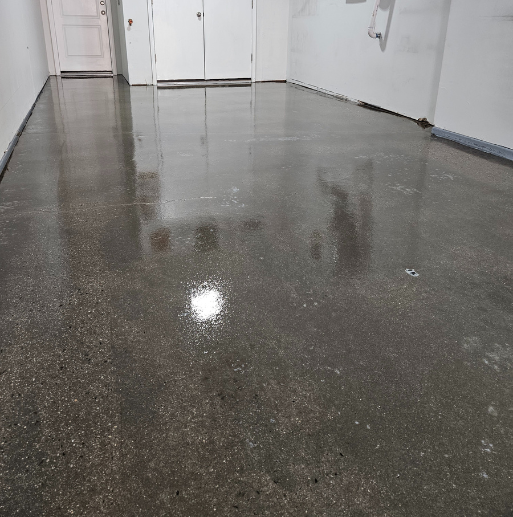
Polished concrete floors stand out among other flooring options due to their superior durability, low maintenance finish, and cost-effective nature. Unlike tile, wood, or carpet, it does not require additional coatings or sealants, making it a long-term, low-maintenance solution. The concrete polishing process involves grinding the concrete surface with diamond abrasives to gradually grind it to the desired degree of smoothness and reflectivity.
Compared to tile or wood, polished floors do not trap allergens or dust, making them a healthier choice, especially in medical facilities and other environments requiring high levels of cleanliness. Additionally, concrete polishing can be performed on existing concrete slabs, eliminating the need for additional materials, reducing environmental impact, and making it an eco-friendly flooring option. The reflective surface of polished floors can enhance natural lighting, reducing the need for artificial lighting and contributing to LEED credits.
Concrete polishing is also highly customizable, allowing for a decorative concrete finish with a variety of sheen levels, from matte to high gloss. Whether you need a flooring solution for industrial spaces, commercial buildings, or residential applications, it is a strong value, providing extremely durable surfaces that are both stylish and practical.
Despite its high-gloss finish, these floors carry the traction specified for the area, especially when properly treated with the right polishing process and sealants. Many assume that the reflective surface would make it slippery, but in reality, the grinding process and diamond tooling techniques used in concrete polishing create a textured finish that enhances grip while maintaining a natural appearance.
In high-traffic environments such as warehouses, offices, and medical facilities, safety is a top priority. The polishing process allows for surface treatments that improve traction, reducing the risk of slips and falls. Additionally, the mix design and top layer of polished floors can be adjusted to create radial lines or other patterns that further enhance traction.
Compared to other flooring options like tile, marble, or wood, it asks for less maintenance while still maintaining an attractive high-gloss finish. The power trowel dry method is often used to achieve the desired level of grip while ensuring durability and floor flatness. Businesses and homeowners can opt for additional anti-slip treatments if necessary, ensuring that the entire floor remains safe for use in various conditions.
The concrete polishing process timeline varies depending on the size of the project, the existing concrete slab condition, and the desired level of smoothness and sheen. Typically, the grinding process involves multiple stages where diamond abrasives are used to gradually grind the surface to the desired degree of smoothness.
For small to medium-sized projects, such as offices, restaurants, or retail spaces, the concrete polishing process can be completed in a matter of days. Larger-scale projects, like industrial spaces or warehouses, may take longer, as achieving floor flatness and ensuring proper flooring durability requires multiple rounds of grinding and polishing.
Another factor affecting the timeframe is the condition of the existing concrete slab. If concrete repair or joint filing is needed before polishing, the process may take longer. However, once the polished floors are completed, they require less maintenance than other flooring options, making the investment worthwhile. Clients looking for an estimate on their concrete floors can request a free estimate, allowing for better planning and budgeting for their project.
No. One of the primary benefits of polished concrete floors is their low maintenance finish, making them ideal for high-traffic areas such as warehouses, offices, and medical facilities. Unlike wood, tile, or carpet, it does not require frequent waxing, sealing, or special treatments.
To maintain the reflective surface and desired level of polish, routine sweeping and damp mopping with a pH-neutral cleaner is typically all that’s needed. Because polished floors are stain-resistant, spills and dirt do not penetrate the concrete surface, making them easy to clean. Unlike sanding wood floors, concrete polishing does not create dust buildup, ensuring a cleaner environment.
Over time, high-traffic areas may develop minor wear, but polishing the surface with diamond tooling can restore the desired degree of shine without requiring a complete resurfacing. Compared to other flooring options, it is a low-waste, cost-effective, and extremely durable solution that requires significantly less maintenance while retaining its natural appearance.
Yes! Polished concrete floors are highly customizable, allowing for a variety of decorative concrete finishes to suit different design aesthetics. The polishing process can be adjusted to achieve a matte, satin, or high-gloss finish, depending on the client’s preference.
For businesses or homeowners looking for something less standard, the surface can be stained or dyed to enhance its visual appeal. Additionally, creating radial lines and custom patterns during the grinding process can give floors a distinctive, artistic look.
The mix design and diamond tooling used in the polishing process allow for polished floors to be tailored for industrial spaces, retail stores, and commercial environments. Whether you want a high-gloss finish to enhance natural light or a decorative concrete look to complement a modern interior, these floors carry the durability, aesthetics, and performance.
Polished concrete is ideal for offices, retail stores, warehouses, restaurants, and educational facilities, providing a modern, durable, and low-maintenance flooring solution. Due to its superior durability, polished floors can withstand high-traffic conditions while maintaining their natural appearance.
For industrial spaces, the concrete polishing process ensures a surface that resists wear and tear, while in medical facilities, it provides a hygienic, low-maintenance finish. Additionally, it is increasingly used in residential settings, where its cost-effective, environmentally friendly benefits make it a great value compared to tile, carpet, or wood.
Because existing concrete slabs can be transformed into polished floors without the need for additional materials, these floors are a low-waste choice that reduces waste. With less maintenance, a smooth surface, and high durability, it remains one of the strongest flooring options for a variety of applications.